
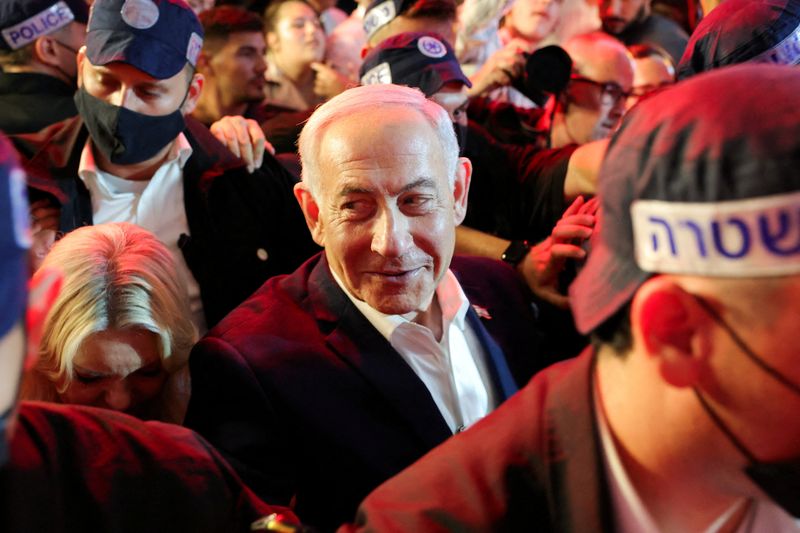
[Financial News] Israeli Prime Minister Benjamin Netanyahu, who is seeking an eighth term, said he was abandoning his previous position of forming a right-wing government and would instead establish a broad coalition government. However, he ruled out cooperating with Arab parties.
According to local media outlets including The Times of Israel (ToI), Netanyahu, who leads the ruling Likud party, made the remarks on the party’s Telegram channel on the 2nd (local time). “We aspire to form a broad government with our existing partners as well as any party that wants to join a coalition and does not support terrorism,” he said. He added that he was open to discussing the matter at any time.
In Israel’s 26th general election, held on the 27th of last month, Likud and the right-wing bloc that had allied with it to form a coalition government with Netanyahu secured a total of 53 of the 120 seats. Before the election, they held 68 seats, above the 61-seat threshold for a majority, but lost 15 seats in this election. Likud won the most seats in the right-wing bloc, with 27—the most of any party in parliament.
The opposition coalition opposed to Netanyahu won 48 seats. The Yashar Party, which leads the opposition coalition, secured 21 seats, while Yisrael Beiteinu, a right-leaning party in the opposition camp, won seven. Beyachad and the Democrats won 12 and eight seats, respectively. Gadi Eisenkot, leader of Yashar, drew attention in this election as Netanyahu’s main challenger. The Arab parties Joint List and Ra’am secured 11 and eight seats, respectively.
Netanyahu, who has served a total of 19 years as prime minister, said in a speech on the 28th, “We must establish a strong right-wing nationalist government,” and, “Jews and a majority of Jewish nationalists (Zionists) must unite.” He also ruled out a government supported by Arab parties.
In a Telegram message on the 2nd, Netanyahu also named Ra’am and Joint List, criticizing them as “parties that support terrorism and deny the very existence of the Jewish state,” and claiming, “The Israeli public does not want a government that depends on them.” Joint List had earlier said it could provide support from outside the opposition coalition opposed to Netanyahu.
Netanyahu’s message that day is thought to mean that he could form an alliance with right-wing parties even within the opposition camp that opposes him. “A clear majority of the Jewish public chose Likud as the largest party and me as the prime minister to lead the next government,” Netanyahu said, emphasizing, “We have been ready from the outset to form a broad-based national government.”
[email protected] Park Jong-won Reporter
