

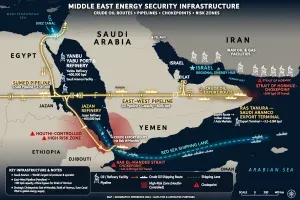
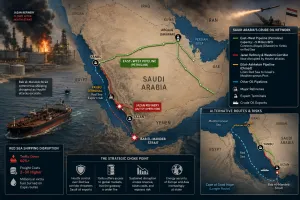
Saudi Aramco Pipeline: The smoke was still hanging low over Yanbu when the reality of the Red Sea blockade hit the operations desk at Saudi Aramco. For weeks, the calculus had been simple: take the long way around the cape, absorb the freight hikes, or cross fingers that the patrols hold. But when a Houthi strike closed the Jazan refinery and disrupted the western corridor, the margins vanished. Riyadh’s crude export network, engineered to project invulnerability, is suddenly bleeding from the edges.
Commercial shipping through the Bab el-Mandeb Strait has slowed to a crawl, and tankers are burning millions in diverted fuel just to reach European ports. The East-West Pipeline was supposed to be the ultimate safety valve, carrying millions of barrels away from the Persian Gulf straight to the Red Sea coast. Yet, reaching Yanbu only drops the oil at the mouth of a hostile gateway. If the corridor stays under sustained fire, the Kingdom is running out of map.
The Saudi Aramco’s Secret Blueprint of ’68
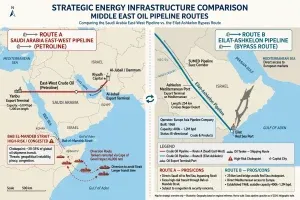
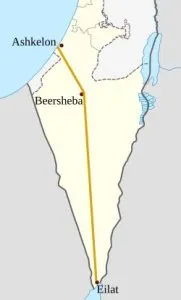
Hidden in plain sight across the Negev Desert lies an alternative born of a completely different era: a 254-kilometre pipeline running from Eilat on the Red Sea to Ashkelon on the Mediterranean. Built in secret during the late 1960s as a joint venture between Israel and Imperial Iran under the Shah, the infrastructure was designed to bypass the Suez Canal entirely.
Declassified CIA files show American intelligence tracked the project closely, estimating it could shift tens of millions of tonnes annually cheaper than traditional maritime routes. After the 1979 Islamic Revolution severed Tehran-Tel Aviv ties, Israel took full control under the Europe Asia Pipeline Company (EAPC), locking operations behind strict national security secrecy provisions.
The Israeli Pitch and the Infrastructure Wall
Today, Israeli officials are openly pitching that very infrastructure to Washington and regional planners as a lifeline for Saudi energy security. OSINT analyst Jay Letni notes that Israel Energy Minister Eli Cohen recently pushed a concrete proposal to connect Saudi Arabia directly to Eilat.
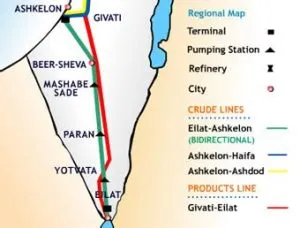
The northbound configuration could theoretically handle between 400,000 and 1.2 million barrels per day—a useful supplement, though far short of total Saudi volumes. Yet, the physical hurdles are immense. Eilat’s port activity collapsed under the Houthi campaign, and upgrading the facilities to handle Saudi supertankers would require billions in dredging, expanded tank farms, and hardened security against drone strikes.
Politics, Proxies, and Regional Exposure
The true obstacle, however, is not engineering; it is politics. Riyadh continues to condition any normalization with Israel on tangible progress toward Palestinian statehood, a red line Israel’s current government rejects. Israel’s attempt to frame the pipeline as a pragmatic workaround—using shared infrastructure to force economic integration—runs straight into the reality of Arab public opinion and fierce Iranian opposition.
If Saudi oil were to cross Israeli territory, Tehran would immediately weaponize the narrative, framing the arrangement as a direct Saudi-Israeli axis. The Houthis would seize on the partnership to justify further escalation, exposing Riyadh to severe regional backlash. While Washington would quietly welcome any move that diversifies European supply away from chokepoints, the energy security upside may still fall short of the heavy political cost.
Also Read: US Saudi Airstrikes in Iraq: Joint Operation Targets Iran-Backed Militia Sites After Drone Attacks

