Yunus Türk
02 July 2026•Update: 02 July 2026
- Türkiye plans alternative trade route to Strait of Hormuz via revived Hejaz Railway project, minister says
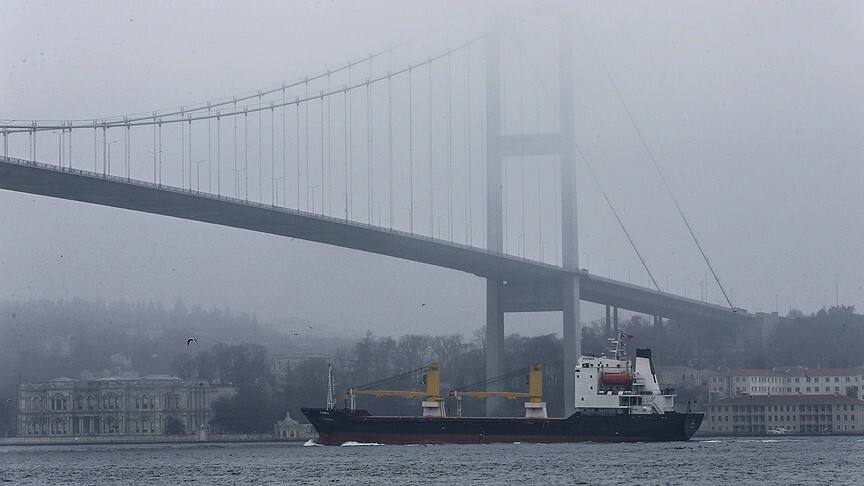
The Turkish Straits are among the most critical passage points for global trade and energy supply security, with more than 2 million vessels passing through them over the past 20 years, Türkiye’s Minister of Transport and Infrastructure Abdulkadir Uraloglu said Thursday.
Speaking at the opening of the fifth Türkiye Maritime Summit in Istanbul, Uraloglu said maritime transport remains the backbone of global commerce, carrying 88% of world freight, while 85% of Türkiye’s foreign trade by tonnage is handled by sea.
“This global reality also underlines how strategically important our country’s maritime vision and strong commitment to the Blue Homeland are,” Uraloglu said.
Marking the 100th anniversary of Türkiye’s Cabotage Law, Uraloglu said the country is determined to combine its deep-rooted maritime heritage with a forward-looking vision.
“As Türkiye, on the 100th anniversary of the Cabotage Law, we are determined to take our place at the forefront of this race by combining our ancient maritime heritage with the vision of the future. We will unite the second century of Cabotage with the Century of Türkiye,” he said.
Uraloglu said Türkiye’s location at the crossroads of continents, civilizations and historic trade routes has made it a central actor in international supply chains and transport corridors.
“Türkiye has become an indispensable link in both North-South and East-West corridors,” he said, adding that the country’s geostrategic position proves that “no corridor can be imagined without Türkiye.”
Uralogu said recent disruptions around the Strait of Hormuz underscored how vulnerable global transport systems can be and how a single maritime chokepoint can affect world energy supply and supply chains.
“An interruption in this strategic waterway, through which nearly 20% of global oil trade passes, creates a broad impact, from energy security to logistics costs,” he said. “At this point, we must manage not only crises but also risks.”
Uraloglu said Türkiye aims to develop the Middle Corridor into a high-capacity, competitive trade route linking Asia and Europe.
He also highlighted the Development Road Project, which aims to connect the Persian Gulf to Europe through Türkiye, and added that a recently signed memorandum of understanding with Saudi Arabia to revive the new and modern Hejaz Railway would add another major link to this broader logistics network.
“With this project, we plan to offer an alternative trade route to the Strait of Hormuz,” Uraloglu said. “Thus, a new option will emerge for cargo from the Gulf region to Europe, and trade flows will be less affected by possible crises.”
Uraloglu said Türkiye’s geographical position, logistics infrastructure, and central role in energy corridors and stability make it indispensable not only to its region but also to global security.
He said countries that build strong fleets, modern ports and green and smart logistics systems will shape the world of tomorrow.
Reviewing Türkiye’s maritime capacity, Uraloglu said the Turkish-owned merchant fleet reached 2,234 vessels and 51.8 million deadweight tons as of Jan. 1, making it one of the world’s largest fleets.
He added that five Turkish ports — Ambarli, Kocaeli, Tekirdag, Mersin and Aliaga — rank among the world’s 100 busiest ports.
Türkiye also has 85 active shipyards and ranks seventh globally in ship orders and 10th in tonnage. It is second in the world in mega yacht production, third in ship recycling globally and first in Europe, he said.
Uraloglu said Türkiye has signed 65 maritime agreements with 51 countries. An agreement signed with Panama last year increased the number of countries recognizing Turkish seafarers’ certificates of competency to 42.
* Writing by Mucahithan Avcioglu

![Azerbaijan turns SCO partnership into broader Eurasian economic strategy [ANALYSIS]](https://www.azernews.az/media/2023/02/14/fii-jumo_400x400.jpg "Azerbaijan turns SCO partnership into broader Eurasian economic strategy [ANALYSIS]")