
EU leaders have nudged the European Commission to draft legal texts to restrict imports from Israeli settlers, following three months of inertia, which EU diplomats said had caused “frustration” in several capitals.
“The European Council takes note of the Commission’s intention to present options before the Council meeting of 13 July 2026, in light of the deteriorating situation regarding the illegal settlements,” EU leaders said in summit conclusions in Brussels on Friday (19 June).
The July date referred to the next informal talks due by EU foreign ministers.
Several member states, led by France, Sweden, Spain, Belgium, and Ireland, have been calling for a settler-import ban for at least three months.
EU leaders discussed “sanctions against extremist and violent settlement activity in the West Bank; EU-level sanctions against extremist ministers; and a deepening of the distinction between the territory of Israel and the illegal settlements in order to align our trade policy with international law,” French president Emmanuel Macron told reporters after the summit.
And the commission’s hesitation to put forward proposals had caused “frustrations” in the room, an EU diplomat said, adding that this was a “political move” by the EU Commission, which was in charge of proposing measures.
It was not normal in EU due process to wait for an explicit majority before even tabling proposals, the diplomat said.
Israeli allies Germany, Austria, the Czech Republic, Hungary, and the new government in Slovenia were not in favour, while the commission had quibbled whether the move required a consensus or a qualified majority vote (a majority of countries representing at least 65 percent of the total EU population).
“We’re looking forward to the proposal from the commission in respect to Illegal settlements,” said Irish prime minister Micheál Martin on Friday.
“The EU has to send a clear signal that what is happening is unacceptable, in Gaza and in the West Bank,” he said.
EU diplomats estimated that 10 to 12 member states were in favour of banning imports from settlements, while a smaller group was open to considering the proposal.
Overall, the EU imports 15 times more from Israel’s illegal settlements in the occupied territories in the West Bank than from Palestinians themselves.
And the leaders’ message to the EU Commission, led by Ursula von der Leyen, came amid further reports that Israeli settlements were expanding drastically in the West Bank.
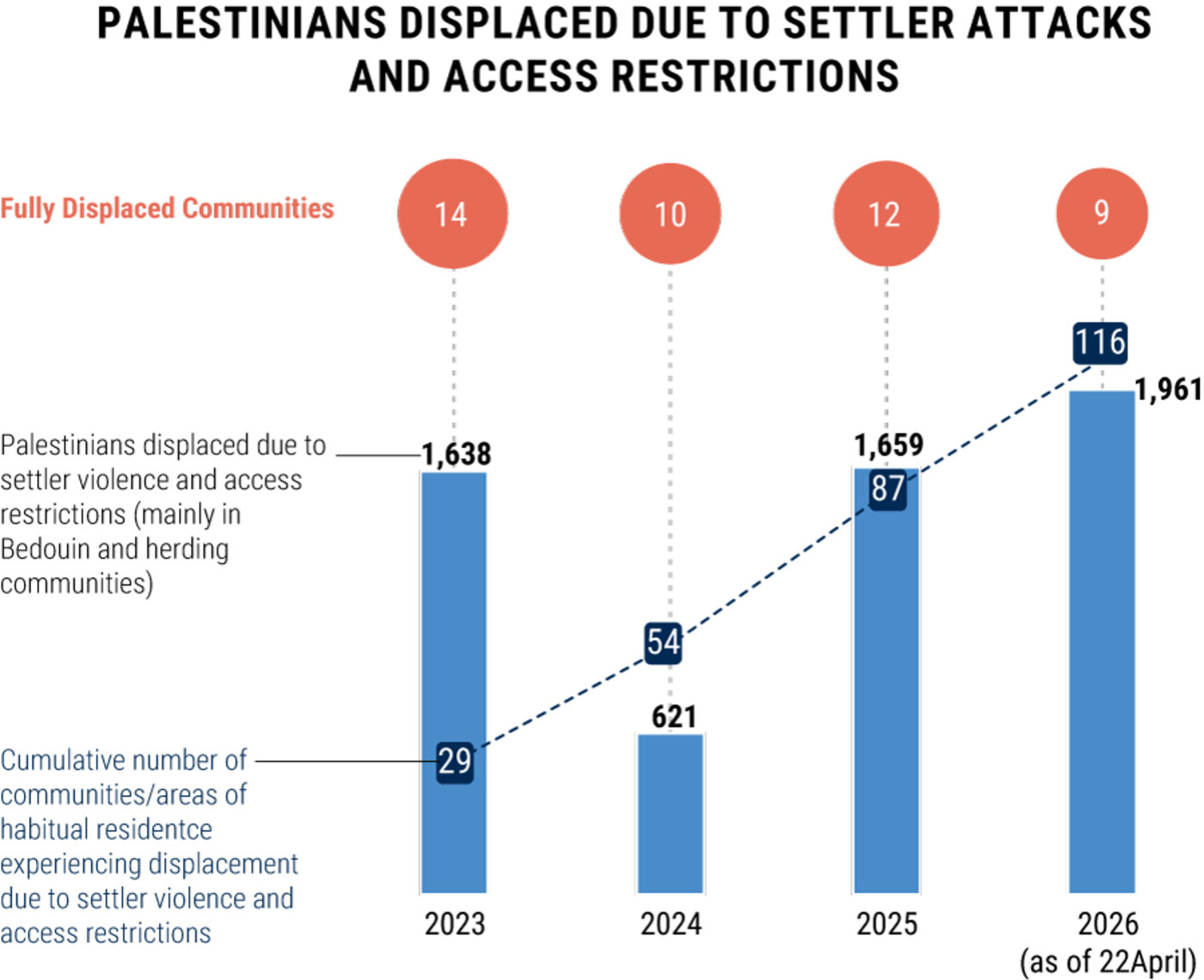
From January 2023 to April 2026, 116 Palestinian communities in the West Bank saw full or partial displacement, according to the UN. At least 5,910 people were forcibly displaced.
EU leaders also criticised extremist Israeli minister Itamar Ben-Gvir, after he degraded some of the 400 Gaza-aid flotilla activists in May, including EU nationals.
He said on Friday on X “all of Lebanon must burn”, after Lebanese fighters killed four Israeli soldiers.
The EU leaders also rejected Israel’s plan to take over the Gaza Strip.
“The European Union firmly rejects Israel’s announcement that it intends to control 70 percent of Gaza’s territory,” Friday’s summit conclusions read.
Kallas Israel clash
The summit coincided with Israeli foreign minister Gideon Sa’ar’s attack on EU foreign relations chief Kaja Kallas.
Sa’ar said on Thursday he would “sever all contact”, as she had allegedly accused Israel of “apartheid” in a closed-doors meeting, according to an anonymous source, quoted by the Euractiv news website in Brussels.

“I am not going to comment on anything that has been said or not said behind closed doors. I have to deal with these kinds of issues every week. So let’s stick to the statements I make publicly every week. That is the European position I am representing,” Kallas said on Thursday ahead of the summit.
“We don’t always see eye to eye with the Israeli,” she said. “We are condemning the violent settlements in the West Bank because it is making this two state solution impossible”.
Macron echoed similar concerns, saying that “in the West Bank, the expansion of the settlement project is undermining the prospect of a Palestinian state and a two-state solution, making it necessary to act quickly.”
German chancellor Friedrich Merz rejected the vocabulary attributed to Kallas, saying: “I do not share that choice of language”.
Estonian prime minister Kristen Michal, from the same liberal party as Kallas, who was a former Estonian prime minister, said he hoped “this will be solved between friends”.
“Kaja Kallas has publicly said that she is representing the EU position, and that should be accepted as such, and hopefully Israel understands that in a rule-based order, Europe is their best friend,” said Michal.
In his X-post, Sa’ar had accused Kallas of “antisemitism … blood libel”.
Israel also made Kallas’ predecessor, ex-EU foreign relations chief Josep Borrell, persona non grata after he had criticised its actions in Gaza.
And while Sa’ar’s move was likely designed to burn Kallas’ name before she presented any draft settler-ban proposal to EU foreign ministers on 13 July, it might also have had Israeli inside-baseball motives.
“For anything coming from Sa’ar, you need to consider his position in the [ruling] Likud party,” said David Issacharoff, a journalist at the Haaretz newspaper in Israel.
“By some [in Likud] he could branded a ‘traitor’ for teaming up with [opposition MKs] Bennett and Lapid in 2021 to try to unseat [prime minister Benjamin] Netanyahu … So now that Sa’ar’s back in Likud, and before the Likud primaries [in July], for the party list in the general elections [in September], he needs to prove he was always a right-wing Likudnik,” Issacharoff said.
“We’ll see this with all the right-wing populism the foreign ministry puts at his disposal, like the Kallas move,” added Issacharoff.