

The decline followed Intel’s financial report Thursday, in which the company attributed its weaker earnings outlook mainly to conditions in the global semiconductor market and production bottlenecks on manufacturing lines where it had invested heavily to meet surging demand for data center chips. Ironically, the surge in demand for chips powering the artificial intelligence industry has helped drive prices higher, while shortages and rising component costs have also made personal computers more expensive, weakening demand and hurting Intel’s earnings.
Sources at Intel Israel said Sunday that the stock’s sharp decline was primarily driven by the company’s lower-than-expected revenue forecast for the fourth quarter, reflecting falling PC sales, rather than the disaster that occurred about two weeks earlier at Fab 28, Intel’s semiconductor manufacturing facility in Kiryat Gat. After a two-week shutdown of the production line, operations at the facility are resuming Sunday.
Nevertheless, despite those assurances, the gas explosion in the factory yard, which killed Ilya Chechulin, 49, and Yakir Kosashvili, 35, and left another worker seriously injured, is expected to have a substantial impact on Intel’s revenue. According to Chief Financial Officer David Zinsner, the incident is expected to reduce fourth-quarter revenue by approximately $300 million and lower gross margin by about 2 percentage points. A similar revenue impact is expected in the first quarter of 2027, bringing the preliminary estimate for the two quarters to roughly $600 million. The disruption is also expected to constrain the supply of chips intended for cloud computing customers.
The Kiryat Gat facility primarily produces 10-nanometer chips for server farms, also known as data centers. Police, firefighters and specialized hazardous materials teams at the scene initially assessed that the explosion resulted from a technical malfunction while a truck was being connected to gas storage tanks. The fire that followed involved nitrogen trifluoride (NF₃), a nonflammable but toxic gas that is dangerous if inhaled.
The incident was extremely unusual, and the circumstances of the malfunction remain under investigation. Because of the particular sensitivity of the materials used in semiconductor manufacturing, Intel’s production facilities operate under some of the world’s most stringent safety standards.
According to one Intel employee, “They wouldn’t let us leave the factory to go home until the evening because they were concerned people could be harmed by the hazardous materials. I received dozens of phone calls and WhatsApp messages from family and friends asking if I was okay. I had to reassure everyone.”
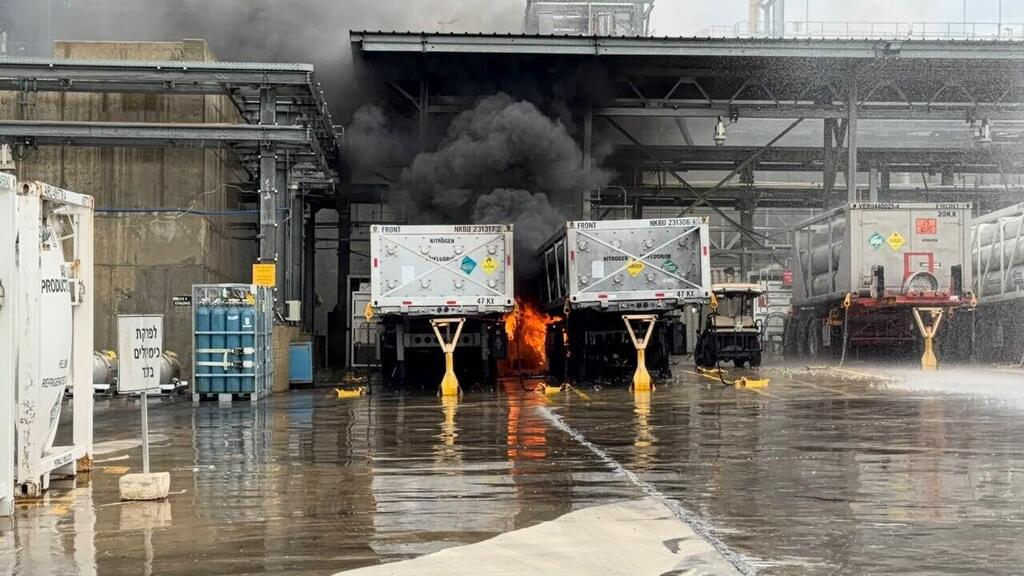
The explosion at Intel’s Kiryat Gat factory
(Photo: Israel Fire and Rescue Authority)
The blow to Intel is particularly severe because, in recent months, the company had appeared to be getting back on track under its new CEO, Lip-Bu Tan. The U.S. government acquired a stake of approximately 10% in the company, while Nvidia also purchased a significant holding.
One Intel Israel employee, who asked to remain anonymous, said, “It’s not exactly an atmosphere of doom and gloom, but concerns about the future are resurfacing, and naturally, so are fears of layoffs.”
Another employee said Intel staff had become accustomed to the company’s ups and downs, including difficult periods involving its stock price, but added, “At the end of the day, the atmosphere is good, and we believe the company will return to where it was.”
Intel Israel has undergone several rounds of layoffs in recent years. At the end of 2024 and the beginning of 2025, approximately 1,000 employees were laid off, and another round began in April 2025.
In July 2025, the cuts reached Kiryat Gat for the first time. Up to 200 employees, primarily middle managers and technicians at the Remote Operations Center (ROC), were summoned to pre-dismissal hearings as the factory introduced automation systems. Employees who were laid off received severance packages averaging eight to 10 months’ salary, while some veteran employees received packages worth up to 19 months’ salary.
In July of this year, Intel launched a smaller round of cuts in its data center division, but the impact on Israel was negligible because most of the company’s local development activity is concentrated in its PC processor division.
However, analysts in the United States have argued that the sharp decline in Intel’s stock price was excessive. Despite weakness in the personal computer market, demand for server chips continues to rise, data center revenue increased by nearly 80% year over year, and the company has recently expanded its manufacturing activity.
Its new processors, including Panther Lake, which was developed in Israel, now account for almost one-third of consumer processor revenue, compared with less than 5% at the beginning of the year. The company’s newer custom-chip business has also tripled in size over three years.
Intel said in response: “Past experience shows that hasty conclusions should not be drawn about the company’s condition based on fluctuations reflecting market sentiment at any given moment. The latest results point to positive trends: Intel reported third-quarter revenue of $16.5 billion, beating forecasts for the eighth consecutive quarter, while its Data Center and AI division grew by 78%.
“The stock reacted to the fourth-quarter outlook, which is influenced primarily by the slowdown in the personal computer market due to the industry-wide memory shortage.
“Intel CFO David Zinsner explained during the analyst call that the Kiryat Gat incident is expected to have an impact of approximately $300 million on fourth-quarter revenue and about 2 percentage points on gross margin, and noted that production at Fab 28 is beginning to resume.
“These are specific, temporary challenges that do not change the company’s direction. As CEO Lip-Bu Tan noted during the analyst call, over the past year and a half Intel has already made significant adjustments to its workforce structure, reduced layers of middle management and bureaucracy, and assembled an almost entirely new leadership team.”