

I recently returned from a week in Israel and the West Bank leading a J Street delegation of former national security officials. We toured the Gaza envelope, the West Bank, and Jerusalem and met with Israeli and Palestinian politicians, security officials, civil society organizations, and many others who continue to shape policy on both sides. I also learned a great deal engaging with many of my former U.S. government colleagues as we discussed what we were seeing on the ground and the implications for U.S. policy and politics – especially the debate in the Democratic Party.
My biggest conclusion from the trip is that the United States has more leverage over Israel than at any point I can remember in my career. But there is also a real danger that we will squander it if we fail to use it wisely. I came back with a new determination to turn that leverage into actual change on the ground that benefits Israeli, Palestinian, and American interests.
For decades, Israeli leaders believed that whatever disagreements they had with an American administration would eventually pass. They could wait out a president who decided to press them on the Palestinian issue. Bipartisan support in Congress would be there no matter what. The American public would remain broadly pro-Israel. The relationship itself was never truly at risk.
That assumption no longer exists.
Across Israel’s political spectrum – particularly among leaders outside Netanyahu’s coalition – there is growing recognition that the relationship has fundamentally changed. They understand that Democrats have had enough of Netanyahu and his extremist partners and will no longer support a blank check. But they also see JD Vance sharply criticizing Israeli policy, and they read public opinion polls showing the dramatic drop in Israel’s standing among American voters – not just Democrats but also independents and young Republicans. Many Israeli policymakers now believe that if Israel continues on its current course, the United States could eventually walk away – a possibility that matters far more than whether a particular shipment of precision-guided munitions is delayed. Fear of a clean break therefore gives current and future American leaders unprecedented leverage over Israeli actions.
But the unprecedented pressure on the relationship also comes at a time of unprecedented positive leverage. Arab governments have never been more interested in integrating Israel into the region through economic cooperation, security partnerships, and normalization. The continued tensions with Iran and the effectiveness and importance of regional ballistic missile and rocket defense during recent wars have hammered this point home.
Meanwhile, the horrors of October 7 and the destabilizing effects of the horrific subsequent war in Gaza across the Middle East also mean that these same Arab governments have never been clearer that meaningful progress on the Palestinian issue is both a prerequisite for Israel’s integration and a necessity for the regional stability they are desperate for. The same countries that can help provide Israel with enormous strategic opportunities are also insisting that the status quo is no longer acceptable.
For much of my career, strategies for advancing Israeli-Palestinian peace relied largely on persuading Israeli leaders that compromise was in their own long-term enlightened self-interest. I still believe that is true.
But today policymakers can go further.
For the first time in decades, the United States can both impose credible negative consequences and offer meaningful positive incentives.
That creates an extraordinary opportunity.
There are, however, two serious risks.
The first is in Israel. If Netanyahu returns to power leading another far-right coalition committed to annexation and permanent occupation, he may simply refuse to respond to American pressure. In that scenario, future Democratic administrations could conclude that the relationship itself is no longer worth preserving and begin dismantling it piece by piece. That would be a strategic failure for Israelis, Palestinians, and the United States alike.
The second danger is that the level of anger in the United States is already too high and that instead of using this newfound leverage to advance policy goals, we mistakenly treat the leverage itself as the policy goal.
Much of today’s debate centers on how to punish Israel. But punishment is not a helpful policy objective. Leverage is simply a tool. The question is not how much pressure to apply. The question is what outcome that pressure can achieve. So let’s actually lay out a strategy.
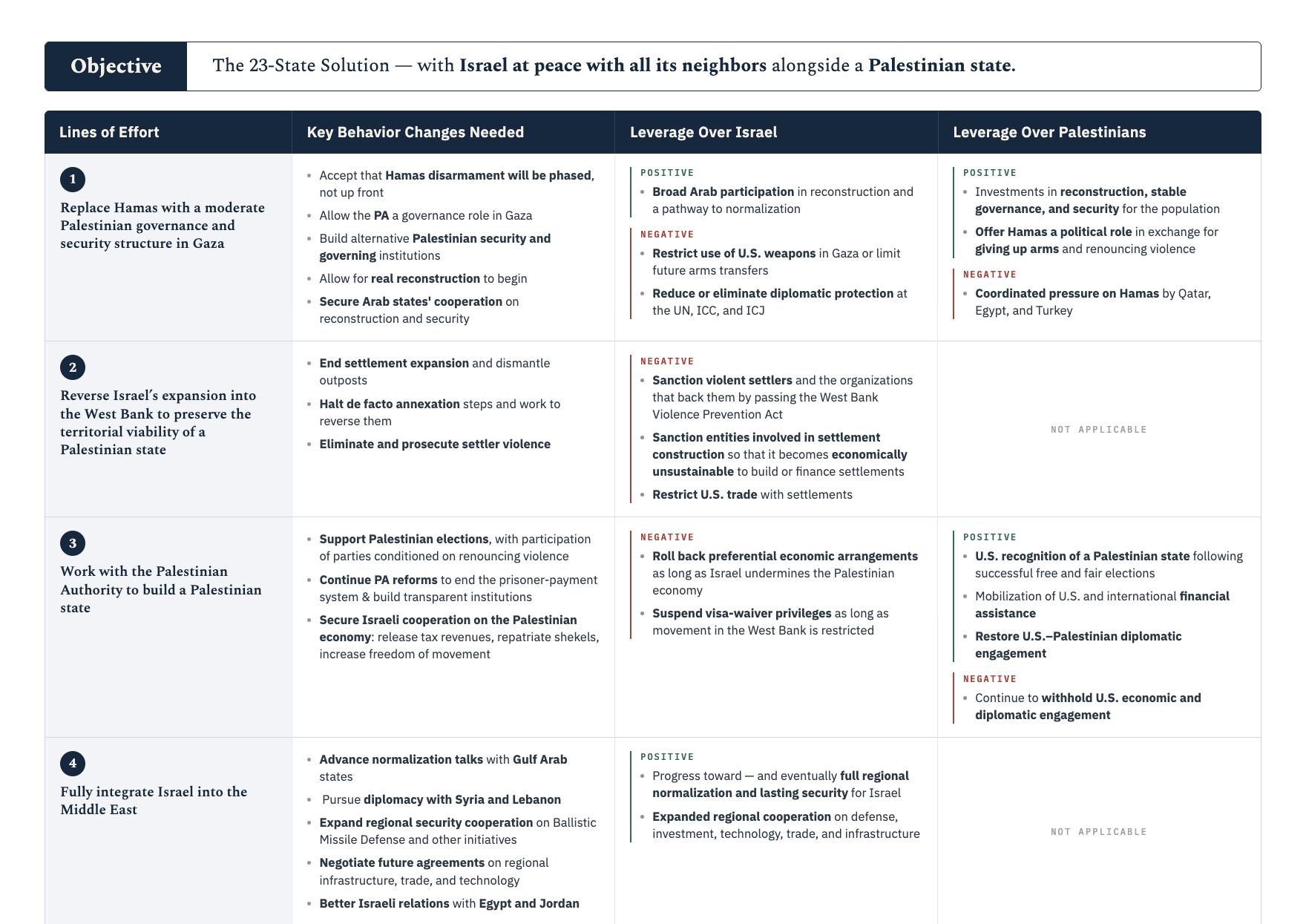
The objective should be clear: a secure Israel at peace, and fully integrated into the Middle East, living alongside an independent Palestinian state also secure and at peace. A true “23-state solution” in which Israel enjoys normal relations with every Arab state while Palestinians finally achieve freedom.
Such an outcome would create a more stable and prosperous Middle East, reduce the need for American military involvement, strengthen regional cooperation against common threats, and finally remove one of the most persistent strategic challenges confronting U.S. foreign policy.
Achieving that objective requires using American leverage as part of an integrated strategy rather than treating leverage as an end in itself. Here are four key lines of effort to do that.
[Note: At the end of this post I have a table summarizing this approach]
The first priority is replacing Hamas—not simply militarily, but politically and institutionally.
The broad outlines of the 20-point plan put forward by the United States and agreed to by Hamas, Israel, and the international community through UN Security Council Resolution 2803 are sound. Building alternative Palestinian security forces, developing an alternative governing authority, gradually replacing Hamas over time, and bringing regional partners into reconstruction and stabilization all reflect ideas that many of us worked on early in the war.
The problem is execution.
First, Israel continues to insist on complete disarmament of Hamas before any meaningful political process begins. Historically, disarmament processes simply do not work that way. They occur incrementally through negotiated, step-by-step arrangements in which security improvements, withdrawals, governance transitions, and disarmament reinforce one another.
Second, the current approach largely excludes the Palestinian Authority because Netanyahu refuses to strengthen any institution that could eventually reunify Gaza and the West Bank politically. Yet despite all of its shortcomings, the PA remains the only viable governing alternative to Hamas.
Third, the Board of Peace has become an unnecessary distraction. It duplicates institutions that already exist, undermines international legitimacy, fuels suspicion among aid organizations, and reflects domestic political priorities in Washington more than practical requirements inside Gaza.
If these problems are corrected, a realistic pathway exists: build alternative Palestinian security forces, support alternative governance, gradually replace Hamas, and bring Arab states into reconstruction while creating incentives for Hamas to relinquish power over time.
The United States has substantial leverage to make this happen.
The positive leverage toward Israel is enormous. A credible Gaza strategy unlocks Saudi Arabia, the UAE, Qatar, Egypt, and others as partners in reconstruction and opens the door to broader regional integration, as they all have an interest in working together to improve the situation.
The negative leverage is equally clear. If Israel continues to actively undermine this strategy, Washington can use a series of tools, including restricting the use of American weapons in Gaza, limiting future offensive weapons transfers, not shielding Israel diplomatically from the international consequences of its actions in Gaza, and walking away from automatic U.S. protection in forums such as the UN, the ICC, and the ICJ. If Israeli policy directly contradicts American policy, the United States should not bear the diplomatic costs of defending it.
There is leverage on Hamas as well. Hamas is dramatically weaker than it was before October 7. Regional actors – including Egypt, Turkey, Qatar, and others with influence over the organization – can increase pressure for gradual disarmament and relinquishment of governance. They are far more likely to do so if they see both American leadership and genuine Israeli willingness to pursue a realistic political end state where Palestinians govern themselves.
Most importantly, the Palestinian people themselves would gain reconstruction, improved living conditions, restored governance, and a pathway toward a fundamentally different future.
This line of effort will require the greatest use of negative leverage on Israel.
A more moderate Israeli government than Netanyahu’s will likely get serious about addressing settler violence. But it is unlikely to voluntarily reverse years of settlement expansion, illegal outposts, and creeping annexation. The domestic political incentives in Israel simply are not there, and the costs are high.
That means the United States must change those incentives.
Congress should pass the West Bank Violence Prevention Act targeting violent settlers as well as the organizations and institutions that finance and enable them. Many of these organizations are also some of the most important in supporting the overall settler movement.
A Democratic administration can also go further, using executive orders to levy broader financial sanctions tied to illegal construction in the West Bank, restrictions on commerce involving settlements, and coordinated action with European partners.
Financial sanctions are particularly powerful because once the United States designates entities, international financial institutions – including Israeli banks – cut off banking relationships or become reluctant to conduct business with them. The objective is not symbolic punishment. It is to make continued expansion economically and politically unsustainable.
This is one area where sustained coercive leverage is likely to be indispensable as long as it is targeted not at all of Israel but at its activities beyond the Green Line.
Replacing Hamas is impossible without building a credible Palestinian governing alternative.
The Palestinian Authority remains deeply flawed, but it is also the only institution capable of eventually governing both the West Bank and Gaza.
That requires substantial reform and support. I’ve laid it out in much greater detail with my colleague Liam Hamama, but here’s the basic gist.
The PA has already committed to and should move forward with legislative elections later this year and presidential elections thereafter. Participation should be conditioned on renunciation of violence, forcing Hamas either to moderate or to exclude itself from the political process. If carried out freely and fairly, elections would infuse real legitimacy back into the political system.
The PA must also continue reforms already underway under Prime Minister Mohammad Mustafa, including ending the prisoner payment system that has long poisoned the U.S.-Palestinian relationship, improving governance, strengthening transparency, and building more effective institutions.
This is fundamentally a state-building project.
Here, American leverage is largely positive – but that is only because thus far we’ve used almost exclusively negative leverage with the PA, so many of the positive incentives would involve undoing penalties that already exist if the PA changes its behavior.
If free and fair elections occur, the United States should recognize the state of Palestine. As reforms proceed, the United States should restore diplomatic engagement, revisit legislative restrictions that unnecessarily constrain relations with the PLO, encourage broader international recognition of Palestinian statehood, and mobilize substantial financial assistance alongside Saudi Arabia, France, and other partners.
Those benefits, however, should remain conditioned on continued reform. That’s the negative leverage.
The United States also possesses important leverage over Israel to make Palestinian governance viable.
Israel must stop undermining the Palestinian economy. That includes releasing Palestinian tax revenues it currently withholds, allowing Palestinian banks sustained access to the Israeli financial system, and restoring greater freedom of movement throughout the West Bank.
If Israel refuses, the United States should begin imposing consequences via broader aspects of the bilateral relationship – including suspending preferential economic arrangements if Israel continues to withhold revenues, or suspending travel privileges such as the visa waiver program if Israel does nothing to improve freedom of movement for Palestinians in the West Bank. If Israel actively undermines U.S. interests by preventing the emergence of a stable Palestinian governing partner, it should not expect every other aspect of the bilateral relationship to remain untouched.
The final line of effort is where America possesses its greatest positive leverage.
The United States can help facilitate Israeli negotiations with Lebanon, support Israeli engagement with Syria, deepen regional missile defense cooperation, expand Israel’s integration within CENTCOM, encourage better Israeli ties with Egypt and Jordan, and advance regional investment, trade, and infrastructure initiatives such as the India-Middle East-Europe Economic Corridor. And of course it can encourage steps toward the ultimate holy grail of Israel-Saudi normalization and Israel’s full integration into the Middle East.
Regional economic integration, infrastructure development, energy cooperation, transportation links, and trade can fundamentally reshape Israel’s strategic environment.
The remarkable reality today is that many Arab governments want these things too.
But they are equally clear that none of them are politically sustainable without meaningful progress on the Palestinian issue.
The strategic logic for both Israeli-Arab cooperation against Iran and for resolving the Israeli-Palestinian conflict has become stronger simultaneously after October 7.
Those two objectives are no longer competing priorities.
They reinforce one another.
None of these four lines of effort succeeds on its own.
Taken together, they point toward the same destination: Israel secure within recognized borders, fully integrated into the Middle East, alongside an independent Palestinian state. The 23-state solution.
For decades, American policy assumed that if the United States embraced Israel closely enough, Israeli leaders would eventually make difficult choices voluntarily. That has obviously been proven wrong.
Today, too much of the discussion has swung the other way – increasingly treating punishment of Israel as the objective itself. That also won’t work. It won’t serve American interests, and it won’t make life better for Palestinians or Israelis.
America possesses more leverage over Israel – and over the Palestinians – than it has in decades. The challenge now is deciding how to use this leverage strategically, in pursuit of an outcome that advances Israeli security, Palestinian freedom, regional stability and American interests all at once.