54
US-Israel-Iran war has entered a new and potentially even more dangerous phase after Iran reportedly threatened to target the world’s most critical shipping routes after the Strait of Hormuz and even threatened to block the Strait of Hormuz again. The warning came after Iran suspended indirect talks with the US, blaming Israel’s expanding military operations in Lebanon.
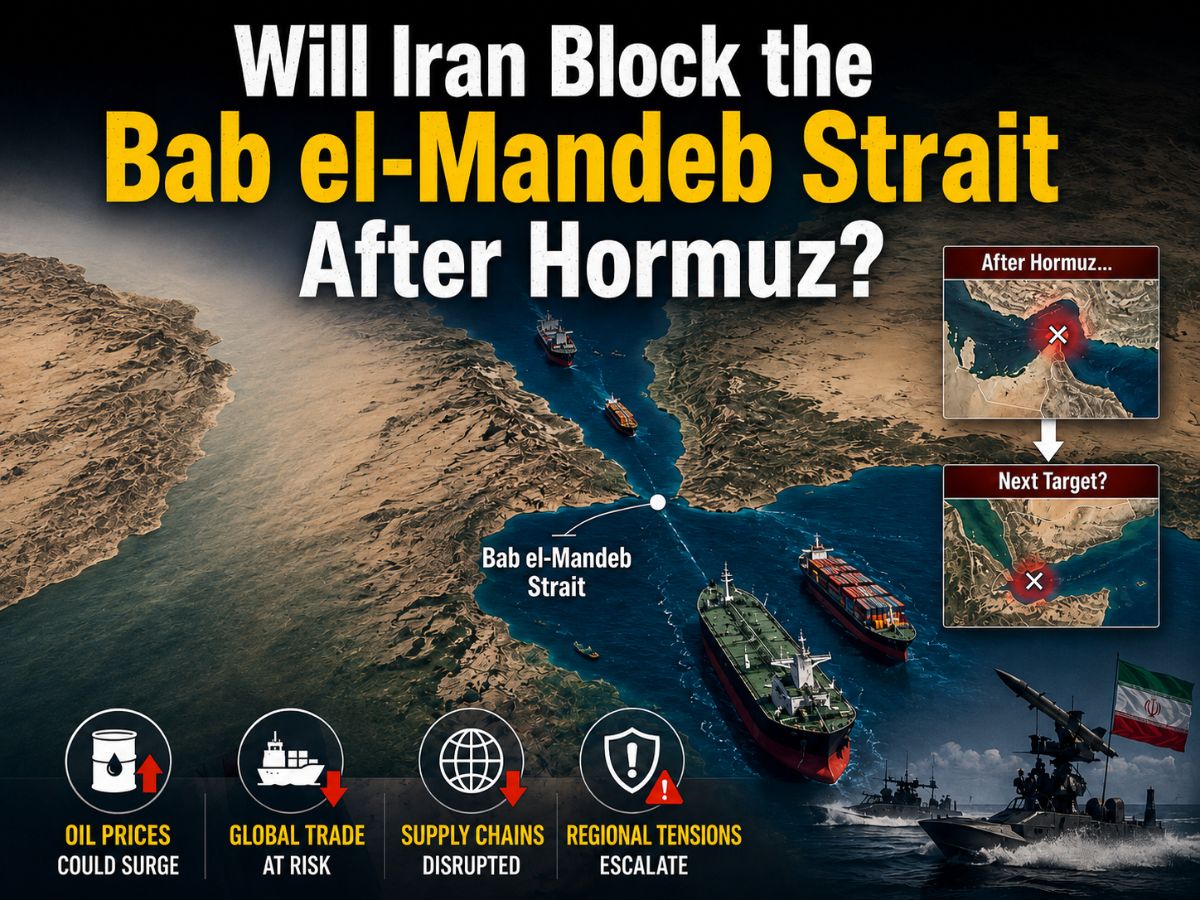
Iranian state-linked media claimed that Iran and its allies are considering action not only in the Strait of Hormuz but also in the Bab el-Mandeb Strait, a vital gateway connecting the Red Sea with global trade routes. The development has raised concerns over oil supplies, shipping costs and the stability of international markets.
US-Israel-Iran War Latest News: Will Iran Block Bab el-Mandeb After the Strait of Hormuz?
Iran’s semi-official Tasnim News Agency reported that Tehran and its allied groups have decided to “activate other fronts, including the Bab el-Mandeb Strait” while continuing pressure through the Strait of Hormuz.
The threat followed Iran’s decision to halt message exchanges with the United States through mediators after accusing Israel of violating ceasefire conditions through operations in Lebanon.
Although Iran has not officially announced a blockade of Bab el-Mandeb, the latest statements suggest that the option remains on the table as tensions continue to rise across the region.
What is the Bab el-Mandeb Strait?
The Bab el-Mandeb Strait is a narrow maritime passage that connects the Red Sea to the Gulf of Aden and the Arabian Sea. Located between Yemen on one side and Djibouti and Eritrea on the other, it serves as a crucial link between Asia, Europe and Africa.
Often referred to as the “Gate of Tears,” the waterway is one of the world’s most important shipping chokepoints. Millions of barrels of oil, petroleum products and thousands of cargo vessels pass through it every year on their way to and from the Suez Canal.
US-Israel-Iran War Latest News: Why is the Bab el-Mandeb Strait Important?
The importance of Bab el-Mandeb has increased significantly since disruptions affected shipping through the Strait of Hormuz. Gulf countries, especially Saudi Arabia, have increasingly relied on Red Sea export routes to move crude oil to international buyers.
As Noam Raydan, a senior fellow at The Washington Institute for Near East Policy, told TIME, “The Bab el-Mandeb, just like Hormuz, is critical for the global economy. It is a chokepoint through which you have various ships, container ships, oil tankers or carriers that move between different regions or continents.”
The route also handles a significant share of global container traffic, making it vital for international supply chains and energy security.
What Could Happen if Bab el-Mandeb Is Blocked?
Experts warn that a closure of Bab el-Mandeb could severely disrupt global trade and energy markets. Ships may have to avoid the Red Sea entirely and sail around the Cape of Good Hope in southern Africa, adding thousands of kilometres and several weeks to voyages. This would increase fuel costs, shipping expenses and delivery times.
Elisabeth Kendall, a West Asia specialist and the president of Girton College at Cambridge University, told Al Jazeera, “If you have restrictions on the Strait of Hormuz at the same time as restrictions are escalating in the Bab al-Mandeb, then you really will disrupt, if not cripple, trade toward Europe.”
Oil prices have already jumped sharply following reports of Iran’s latest threat, highlighting market fears over potential supply disruptions.
US-Israel-Iran War Latest News: Who Controls Bab el-Mandeb Currently?
Iran does not directly control the Bab el-Mandeb Strait. However, Tehran maintains strong ties with Yemen’s Houthis, which operate near the strategic waterway. The Houthis previously targeted commercial vessels in the Red Sea and nearby waters, forcing many shipping companies to reroute vessels around Africa.
Because of this influence, analysts believe Iran could attempt to disrupt shipping in the area through allied groups rather than direct military action.
US-Iran Peace Deal Collapsed?
The prospects for a US-Iran peace agreement have weakened significantly after Tehran suspended indirect communications with Washington. Iranian officials linked the decision to Israel’s military actions in Lebanon and insisted that discussions cannot continue while those operations remain ongoing.
The suspension has cast fresh doubt over diplomatic efforts aimed at reducing tensions and reopening critical maritime routes.
What’s Next in the US-Israel-Iran War?
For now, Iran has not officially closed the Bab el-Mandeb Strait. However, the threat alone has rattled global markets and raised fears of a wider regional confrontation. Governments, shipping companies and energy traders are closely monitoring the situation as diplomatic efforts struggle to prevent another major disruption to global trade.
If tensions continue to rise and Iran or its allies take action in Bab el-Mandeb, the world could face higher oil prices, longer shipping routes and renewed pressure on already fragile supply chains.