

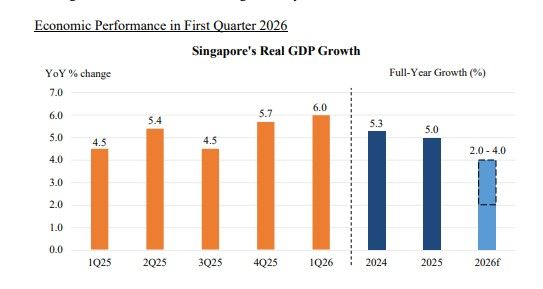
Singapore maintained its 2026 gross domestic product (GDP) growth forecast at 2 to 4 per cent despite significantly higher downside risks arising from the US-Israel-Iran conflict, the Ministry of Trade and Industry (MTI) said on 25 May 2026.
In its latest economic survey report, MTI said the Singapore economy performed better than expected in the first quarter of 2026, supported largely by strong artificial intelligence (AI)-related demand across key sectors.
The economy expanded 6 per cent year on year in the January-to-March quarter, extending the 5.7 per cent growth recorded in the previous quarter.
The figure was higher than MTI’s earlier estimate of 4.6 per cent announced in April.
On a quarter-on-quarter seasonally adjusted basis, the economy grew 1 per cent, easing from the 1.3 per cent expansion in the preceding quarter.
AI demand drives economic growth
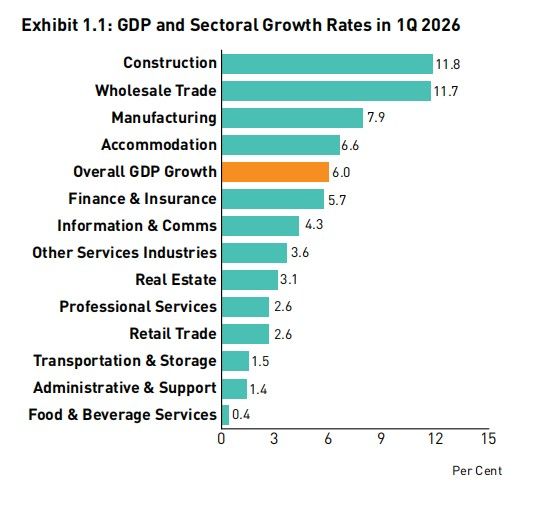
MTI said growth in the first quarter was led by strong performances in the wholesale trade, manufacturing, and finance and insurance sectors.
“Robust AI-related demand led to growth in the machinery, equipment and supplies segment of the wholesale trade sector, as well as the electronics and precision engineering clusters within the manufacturing sector,” MTI said in its report.
The manufacturing sector expanded 7.9 per cent year on year during the quarter, while wholesale trade grew 11.7 per cent.
The finance and insurance sector recorded growth of 5.7 per cent, supported by steady performances in banking, fund management and securities dealing activities.
MTI said sustained global AI-related capital spending is expected to remain a major growth driver for Singapore’s electronics and precision engineering industries through the rest of 2026.
“In particular, demand for AI-related semiconductors such as networking and memory chips from the data centre end-market is expected to remain robust for the rest of 2026,” the ministry said.
The information and communications sector also grew 4.3 per cent year on year, supported by continued enterprise demand for AI-enabled and digital solutions.
Middle East conflict clouds outlook
Despite the stronger-than-expected first-quarter performance, MTI warned that the global economic outlook has weakened considerably following the outbreak of conflict involving the United States, Israel and Iran.
The ministry said disruptions to energy supplies and key industrial inputs caused by the blockade of the Strait of Hormuz have pushed up global costs and intensified inflationary pressures.
Around 20 per cent of global oil consumption passes through the Strait of Hormuz.
Since the conflict began, oil prices have surged while supply chain disruptions have affected sectors dependent on energy commodities and raw materials such as fertiliser and aluminium.
MTI said the inflationary impact is “expected to erode real incomes and dampen consumption, as well as cause a tightening in global financial conditions”.
The ministry added that prolonged disruptions to energy supply chains could significantly slow global growth.
Singapore’s outward-oriented sectors have already begun facing pressure.
MTI said oil refineries and petrochemical crackers have reduced operating rates, while several downstream petrochemical and specialty chemical firms have declared force majeure.
The fuels and chemicals segment within wholesale trade also recorded weaker trading volumes due to supply disruptions.
Higher fuel costs are additionally expected to weigh on the transportation and storage sector, particularly air and water transport services.
External demand outlook weakens
MTI said Singapore’s external demand outlook has weakened compared with its assessment in February 2026.
The ministry noted that growth forecasts for major economies, including the United States and the Eurozone, have been downgraded amid rising inflation, weaker consumer sentiment and slowing global demand.
The World Trade Organization projected in March that global merchandise trade volume growth would slow to 1.9 per cent in 2026, down from 4.6 per cent in 2025.
Separately, the International Monetary Fund lowered its global growth forecast for 2026 to 3.1 per cent in April, from an earlier estimate of 3.3 per cent.
At the same time, MTI said the outlook for United States tariffs remains broadly unchanged.
The ministry noted that Washington is expected to restore reciprocal tariff rates in the second half of 2026 through alternative trade policy mechanisms.
Domestic sectors remain resilient
Domestically oriented sectors in Singapore are expected to remain relatively resilient despite weaker consumer sentiment.
MTI said the construction sector will continue to be supported by public sector projects, while new private residential launches and stable owner-occupier demand are expected to support the real estate sector.
The ministry also said earlier disbursement of CDC vouchers in June 2026 and enhancements to Budget 2026 cost-of-living support measures should help cushion weaker household spending.
Retail trade grew 2.6 per cent year on year in the first quarter, while the accommodation sector expanded 6.6 per cent.
The food and beverage services sector posted modest growth of 0.4 per cent.
Nonetheless, MTI cautioned that downside risks to Singapore’s economic outlook have “risen significantly”.
“MTI will continue to monitor developments closely and adjust the GDP growth forecast over the course of the year if necessary,” the ministry said.