
Editor’s note: Emre Diner is a Turkish journalist and foreign policy analyst specialising in the Middle East, energy geopolitics, and international security. This article reflects the author’s personal views and does not necessarily represent those of News.Az.
Oman’s decision to postpone the planned Salalah meeting between Iran and the Gulf states on the future of the Strait of Hormuz has once again exposed the deep crisis of trust shaping regional diplomacy. At the same time, the Yemeni government forces’ counteroffensive against the Houthis in Taiz has demonstrated that the struggle in the Middle East is increasingly concentrated not only in political capitals but also around the gateways to some of the world’s most critical energy and trade routes.
At first glance, the diplomatic deadlock over Hormuz and the renewed military activity in Taiz may appear to be separate developments. In reality, they represent two fronts in the same strategic challenge: the vulnerability of global energy flows and maritime trade to political and military instability.
Iran can exert pressure on energy traffic through the Strait of Hormuz, while the Houthis have demonstrated their ability to threaten shipping linked to the Red Sea and Bab el-Mandeb. Even routes intended to reduce dependence on Hormuz cannot be considered completely insulated from regional instability if insecurity spreads across the Red Sea. Gulf energy exports are therefore increasingly exposed to risks around Hormuz in the east and Bab el-Mandeb in the west.
This changing environment is increasing the strategic value of energy and transport corridors located outside the Middle East’s most vulnerable maritime chokepoints. In particular, the routes extending from Azerbaijan through Georgia and Türkiye to Europe are evolving from commercial infrastructure into increasingly important components of Eurasian energy security.
For Iran, the Strait of Hormuz is far more than a maritime passage. Tehran’s geographical position and military capabilities around the strait provide significant leverage in negotiations over sanctions, security arrangements and the broader regional balance of power. Yet a complete and prolonged closure of Hormuz would carry enormous costs for Iran itself, damaging its exports and economic relationships while potentially triggering a wider confrontation.
Tehran therefore does not necessarily need to close the strait to extract strategic value from it. Controlled uncertainty can be enough. Higher perceived risks to vessels, questions over security guarantees and the possibility of disruption can increase freight and insurance costs and inject volatility into global energy markets. In that sense, the strategic value of Hormuz lies not only in the possibility of closure but also in the political and economic price attached to keeping it reliably open.
The postponement of the Salalah meeting reflects this broader crisis of confidence. Gulf states have little incentive to view Hormuz as an isolated technical issue when maritime security elsewhere in the region remains vulnerable. Any arrangement that reduces tension in one chokepoint could lose much of its value if pressure intensifies around another.
This is why developments in Yemen matter far beyond Yemen itself.
Source: Reuters
Taiz occupies a strategically important position along routes connecting Yemen’s interior with the Red Sea coast and the port of Mokha. Military control of elevated positions and supply lines in this area can influence access to Bab el-Mandeb, one of the world’s most important maritime passages.
The Yemeni government forces’ recapture of positions from the Houthis may therefore have significance beyond the immediate battlefield. The broader objective is not simply territorial. Preventing the Houthis from consolidating military advantages along routes towards the Red Sea is directly connected to the security environment surrounding international shipping.
At the same time, the Houthis should not be reduced to a force mechanically implementing every instruction from Tehran. The movement has its own political, military and economic objectives inside Yemen. Nevertheless, additional pressure on Red Sea shipping can indirectly strengthen Iran’s regional leverage by increasing the number of pressure points affecting Gulf states and their partners.
The fighting in Taiz may be local, but the consequences of instability around Bab el-Mandeb are unmistakably regional and global.
It is against this background that Azerbaijan’s strategic importance becomes more apparent.
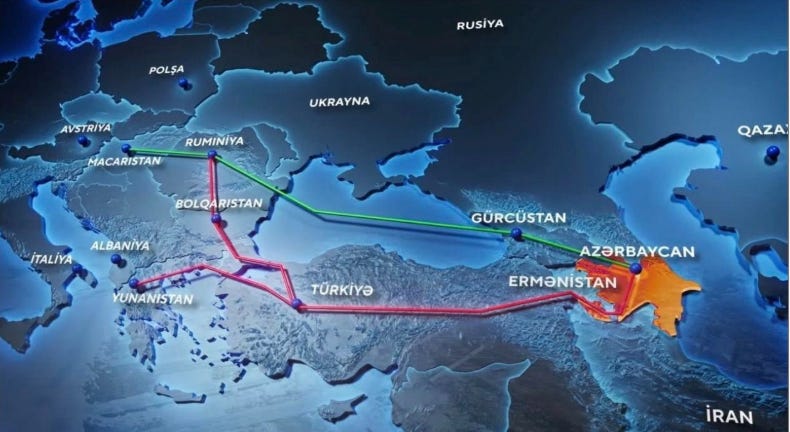
Azerbaijan’s advantage is not simply that it possesses oil and natural gas resources. Its deeper geopolitical strength lies in the existence of infrastructure capable of carrying Caspian energy westwards through Georgia and Türkiye without relying on the Middle East’s principal maritime chokepoints.
The Baku-Tbilisi-Ceyhan oil pipeline remains one of the most important components of this architecture. By carrying Caspian crude through Georgia to Türkiye’s Mediterranean coast, the pipeline created a direct westward export route that bypasses both Russia and the vulnerable Gulf maritime system.
Its strategic importance should not be measured solely by the volume of Azerbaijani crude currently flowing through it. Existing infrastructure also provides optionality. In an increasingly fragmented energy environment, spare or expandable transport capacity can itself become a strategic asset, particularly if additional Caspian and Central Asian resources are directed westwards.
Natural gas has become even more important to Azerbaijan’s relationship with Europe.
The Southern Gas Corridor connects Azerbaijani gas with Türkiye and European markets through a chain of infrastructure extending across Georgia, Türkiye and Southeastern Europe. Azerbaijan exported 25.2 billion cubic metres of natural gas in 2025, with 12.8 billion cubic metres delivered to Europe. The initial expansion of the Trans Adriatic Pipeline’s annual capacity by 1.2 billion cubic metres, alongside the extension of Azerbaijani gas deliveries to Germany and Austria in early 2026, further broadened the geographical reach of this partnership.
The significance of these developments goes beyond volumes.
Source: Reuters
Periods of geopolitical crisis teach energy markets a recurring lesson: additional supply matters, but the reliability of the route delivering that supply matters almost as much. A barrel of oil or a cubic metre of gas cannot strengthen energy security if the infrastructure carrying it remains vulnerable to repeated military disruption.
This is where Azerbaijan’s position acquires additional strategic value.
Baku can increasingly present itself not merely as an energy producer but as a reliable partner situated at the centre of an alternative east-west connectivity system. The country’s energy diplomacy is therefore becoming inseparable from its transport diplomacy.
Türkiye is central to this equation.
The Trans-Anatolian Natural Gas Pipeline, the Baku-Tbilisi-Ceyhan pipeline and the Baku-Tbilisi-Kars railway have transformed Azerbaijani-Turkish cooperation into a broader strategic architecture linking the Caspian basin with the Mediterranean and Europe.
Türkiye is more than a transit country within this structure. Through Ceyhan, its domestic energy infrastructure, connections to European markets and expanding railway network, it provides the geographical scale necessary to convert Azerbaijan’s resources and location into broader geopolitical influence.
When Azerbaijan’s position on the Caspian is combined with Türkiye’s access to European and Mediterranean markets, the result extends beyond a bilateral partnership. It creates the foundations of a broader Eurasian corridor capable of connecting Central Asia with Europe.
This creates several opportunities for Baku. Azerbaijan can deepen long-term energy partnerships with European states, strengthen its position as a transit hub for Central Asian resources and use energy cooperation as the foundation for broader investment, logistics and political partnerships.
The same strategic logic applies to the Middle Corridor.
Instability around Hormuz, Bab el-Mandeb and the wider Red Sea-Suez route affects more than oil and gas. Every serious disruption can increase shipping times, freight rates and insurance premiums while placing additional pressure on international supply chains.
The Trans-Caspian International Transport Route, commonly known as the Middle Corridor, offers an alternative connection between China, Central Asia and European markets through the Caspian Sea, Azerbaijan, Georgia and Türkiye. Freight volumes along the route reached 4.1 million tonnes in 2024, an increase of more than 63 per cent, while World Bank assessments indicate that, with sufficient infrastructure investment and operational improvements, volumes could reach around 11 million tonnes annually by 2030.
Yet geography alone does not guarantee success.
The Middle Corridor continues to face structural challenges, including port capacity, the reliability of Caspian crossings, railway interoperability, customs procedures and border transit times. If Azerbaijan and its partners want to convert geopolitical opportunity into durable economic advantage, infrastructure and regulatory reform must advance together.
Expanding the capacity of the Port of Alat, improving railway connections, harmonising tariffs, digitalising customs procedures and reducing border delays are therefore not merely commercial objectives. They are increasingly elements of geopolitical competitiveness.
The larger lesson emerging from the Middle East is that energy security can no longer be measured solely by production capacity.
How much oil or natural gas a country produces remains important, but so does the route by which those resources reach international markets. Geography, infrastructure, political stability and predictability are becoming inseparable components of the energy security equation.
Azerbaijan is unusually well positioned within this new environment because energy, transport and diplomacy increasingly converge along the same geographical axis.
Baku’s greatest opportunity is therefore not to seek short-term gains from temporary price increases generated by Middle Eastern instability. Such an approach would underestimate the structural shift now taking place. The more important objective is to consolidate Azerbaijan’s reputation as a dependable long-term supplier and a stable centre of Eurasian connectivity.
That will require further expansion of energy infrastructure, long-term supply arrangements with European partners and deeper trans-Caspian cooperation with Central Asian producers. It will also require integrating the Middle Corridor more closely with Azerbaijan’s existing energy infrastructure so that pipelines, ports, railways and logistics facilities increasingly function as components of a single strategic system.
The potential extends beyond Azerbaijani resources themselves. If greater volumes of Central Asian oil, gas and goods move westwards across the Caspian, Azerbaijan’s importance will increasingly derive from being both a producer and a gateway.
That distinction matters.
Resources generate revenue. Corridors generate strategic relevance.
Hormuz and Bab el-Mandeb are once again reminding the world how quickly maritime chokepoints can become sources of global vulnerability. Azerbaijan and Türkiye, by contrast, have spent decades developing an east-west infrastructure network whose strategic value rises whenever traditional routes become less predictable.
The challenge now is to transform that advantage into lasting influence.
As the Middle East’s straits narrow under the pressure of geopolitical rivalry, Azerbaijan’s energy and transport corridor is growing in strategic importance. Whether Baku can turn this moment into durable geopolitical influence will depend on its ability to combine production capacity, infrastructure investment, trans-Caspian integration and long-term diplomacy.
The opportunity is larger than selling more oil or gas. It is about positioning Azerbaijan as one of the indispensable links between Asia and Europe in an era when secure routes may become almost as valuable as the resources they carry.
(If you possess specialized knowledge and wish to contribute, please reach out to us at [email protected]).
