
One year after the landmark Washington meeting, the South Caucasus is increasingly moving away from the legacy of confrontation towards a new framework centred on peace, connectivity and economic cooperation.
he progress achieved since 8 August 2025 has created new opportunities not only for Azerbaijan-Armenia normalisation but also for wider regional integration involving Türkiye, the United States and Central Asia. Transport corridors, trade, energy links and infrastructure projects are becoming increasingly important elements of this emerging architecture.
As diplomatic normalisation advances, the key question is whether these developments can transform the region into a sustainable economic and geopolitical space connecting Türkiye, the South Caucasus and Central Asia.
In an interview with News.Az, Turkish political scientist Emre Diner said that the 8 August 2025 Washington meeting marked a historic turning point for the South Caucasus, as it laid the political foundations for moving from nearly three decades of conflict towards the normalisation of interstate relations.

Photo: Emre Diner, Turkish political scientist
According to him, the significance of the meeting went beyond the signing of diplomatic documents.
“8 August 2025 was a historic turning point for the South Caucasus. In Washington, not only was a diplomatic declaration signed, but the political framework for the transition from nearly 30 years of conflict to the normalisation of interstate relations was also established. In a sense, Azerbaijan’s victory over Armenia was confirmed in the international arena as well,” Diner said.
He noted that one of the key achievements over the past year had been the gradual shift in Azerbaijan-Armenia relations away from the risk of military confrontation and towards discussions on economic connectivity, borders, transportation and mutual trade.
“When we look at the past year, the most important achievement has been that relations between Azerbaijan and Armenia have gradually evolved from the possibility of military confrontation towards discussions on economic connectivity, borders, transportation and mutual trade,” he said.
The expert noted that the beginning of contacts and commercial relations between the parties, discussions on linking energy systems and the emergence of concrete implementation mechanisms regarding TRIPP demonstrated this transformation.
“However, it is still too early to say that the process has been completed. The final peace agreement still needs to be signed,” he stressed.
Diner described 8 August not so much as the date when the war legally ended completely, but as the beginning of the South Caucasus’ transition from an order based on conflict to one based on cooperation.
He emphasised that one of Azerbaijan’s major achievements under President Ilham Aliyev had been the transformation of its military and political superiority into a lasting political advantage and a broader vision for a new regional order.
![How Baku's post-war strategy changed Washington's role in South Caucasus [ANALYSIS]](https://www.azernews.az/media/2026/08/07/6245624572457.png)
Source: AzerTAG
“The main achievement of Azerbaijan under the leadership of President Ilham Aliyev over the past several years has been that it did not simply leave its military and political superiority on the ground as an outcome of the conflict, but transformed it into an effort to establish a new regional order,” he said.
The expert also emphasised that one of President Aliyev’s most important diplomatic achievements was turning the advantage Azerbaijan had gained on the ground into a lasting political advantage.
“After Baku restored its sovereignty over Karabakh, it shifted the agenda from the war itself to the conditions for a peace agreement. President Ilham Aliyev brought the Armenian leadership closer to a political position that openly recognises Azerbaijan’s territorial integrity,” he noted.
The Turkish political scientist also stressed that, after its victory in Karabakh, Azerbaijan was the side that proposed concluding a peace agreement with Armenia and presented its own approach to the principles on which future interstate relations should be based.
“Having achieved victory in Karabakh, Baku became the party that proposed a peace agreement to Armenia after the conflict. It also presented its own approach regarding the fundamental principles on which interstate relations should be built,” he said.
“President Ilham Aliyev also made it clear that the text initialled in Washington was a continuation of this process,” Diner added.
According to him, the process has strategic importance for Türkiye as well.
“From Türkiye’s perspective, this has an additional strategic meaning. Instead of Ankara and Baku pursuing separate Caucasus policies, their coordinated approach is taking the Türkiye-Azerbaijan alliance beyond military cooperation and transforming it into a regional partnership covering transportation, energy and diplomacy,” he said.
Diner believes that the Azerbaijan-Armenia peace process and Türkiye-Armenia normalisation can no longer be viewed separately.
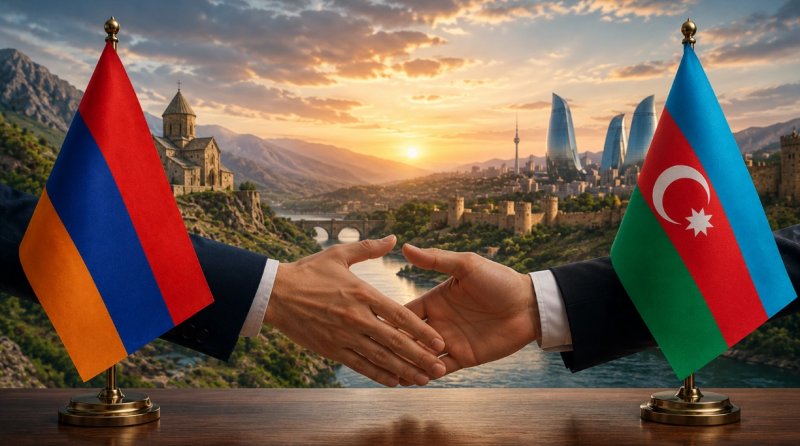
Source: AI
“The two processes can no longer be considered independently of each other. As tensions between Azerbaijan and Armenia decrease, one of the most important political obstacles to Ankara-Yerevan normalisation also weakens,” he said, adding that concrete results were already evident.
He added that direct flights between Türkiye and Armenia were continuing, while in September 2025, the special representatives of both sides had agreed to accelerate the implementation of previously reached arrangements on border crossings.
The expert stressed that, in May 2026, Türkiye also removed an important restriction on direct trade with Armenia. “Therefore, the Washington process and Türkiye-Armenia normalisation have become two parallel processes that reinforce each other,” he said.
The political scientist assessed Ankara’s policy towards Armenia as largely successful, noting that Türkiye had maintained dialogue with Yerevan without disregarding Azerbaijan’s security concerns.
“I believe this policy has been successful to a significant extent,” he said.
“On the one hand, Ankara has continued direct dialogue with Yerevan, while on the other hand, it has not ignored Baku’s security concerns. Türkiye has always remained vigilant regarding possible security risks facing Baku,” Diner noted, adding that in this way, Türkiye prevented the normalisation process with Armenia from creating a new atmosphere of mistrust in its relations with Azerbaijan.
“Therefore, Ankara’s policy prepared the political ground. The second stage will now be to transform this ground into concrete normalisation,” Diner said.
He added that the signing of a final peace agreement between Azerbaijan and Armenia could accelerate the normalisation process between Türkiye and Armenia.
“Yes, after this agreement, the resolution of the border issue could definitely accelerate,” the expert said, adding that once Azerbaijan and Armenia signed the final peace agreement, one of the most important regional political obstacles to Türkiye’s full normalisation with Armenia would have been removed.
“This could accelerate the establishment of diplomatic relations, the opening of the land border, the restoration of the Kars-Gyumri railway and the expansion of mutual trade,” he said.
At the same time, Diner warned that this process would not necessarily move forward automatically, as Armenia’s constitutional arrangements and bilateral issues between the two countries would also determine the pace of the process.
“Baku, in particular, maintains its demand for changes to the Armenian Constitution before the final agreement is signed,” he added.
Diner described the change in the mediation architecture of the South Caucasus as one of the most important outcomes of the Washington process.
“Perhaps the most important result of the Washington process is the transformation of the mediation architecture in the South Caucasus. In the past, Russia was the main external power in the region. Today, however, the United States is becoming one of the direct actors in both the political peace process and regional connectivity projects,” he said.
According to him, TRIPP is the clearest example of this changing role.
“TRIPP is the most concrete indicator of this. The implementation framework developed by the United States and Armenia aims to establish an uninterrupted multimodal transport connection between mainland Azerbaijan and Nakhchivan through Armenian territory,” Diner said.
He noted that this development also creates opportunities for Türkiye, adding that, from Türkiye’s perspective, this presents positive opportunities. The expert stressed that Ankara’s interest was not in seeing the South Caucasus turn into a new arena of competition between major powers, but in strengthening regional ownership and opening transportation routes.
Diner said that the most important economic consequence of lasting peace would be the transformation of the South Caucasus from a “geography of conflict” into an “economic geography”.
“The greatest economic result of lasting peace will be the transformation of the South Caucasus from a geography of conflict into an economic geography,” he said, noting that, from Türkiye’s perspective, the opportunities include strengthening the Türkiye-Nakhchivan-Azerbaijan-Caspian-Central Asia connection, diversifying the Middle Corridor through alternative routes, developing Türkiye-Armenia trade and the border economy, and integrating energy, electricity, railway and digital infrastructure projects.
According to the political scientist, the strategic importance of the process goes beyond the opening of a single transport route.
“The strategic issue here is not simply the opening of a new road. What really matters is the emergence of a new economic space stretching from Türkiye through the South Caucasus and the Caspian Sea to Central Asia,” he said. “If this happens, Azerbaijan will become not only an energy producer but also one of Eurasia’s important logistics hubs, while Türkiye will become one of the main gateways connecting this system with Europe.”
Diner also referred to the US-Azerbaijan Strategic Partnership Charter signed in February 2026, noting that it identifies energy, transportation, digital infrastructure and the transportation of critical minerals through the Middle Corridor among the areas of cooperation.
Looking ahead, Diner identified five developments that he believes will determine the next stage of the peace process.
“The first is when the initialled agreement between Azerbaijan and Armenia will finally be signed. The second is the process of constitutional changes in Armenia, because Baku views this as one of the main issues standing in the way of the final agreement. The third is the actual implementation of TRIPP and the Azerbaijan-Nakhchivan transport connection. The fourth is the gradual opening of the Türkiye-Armenia land border and the establishment of diplomatic relations. The fifth is whether economic normalisation will support political peace,” he said.
According to Diner, the central question surrounding the South Caucasus is gradually changing.
“In my view, the main question for the coming period is increasingly ceasing to be, ‘Will Azerbaijan and Armenia go to war again?’ The question that will need to be asked in the future is whether the peace environment emerging in the South Caucasus can be transformed into a lasting economic and geopolitical order,” he said.
“If this can be achieved, 8 August 2025 will be remembered as a historic turning point not only in Azerbaijan-Armenia relations, but also in the reshaping of the geography stretching from Türkiye to Central Asia,” Diner concluded.