
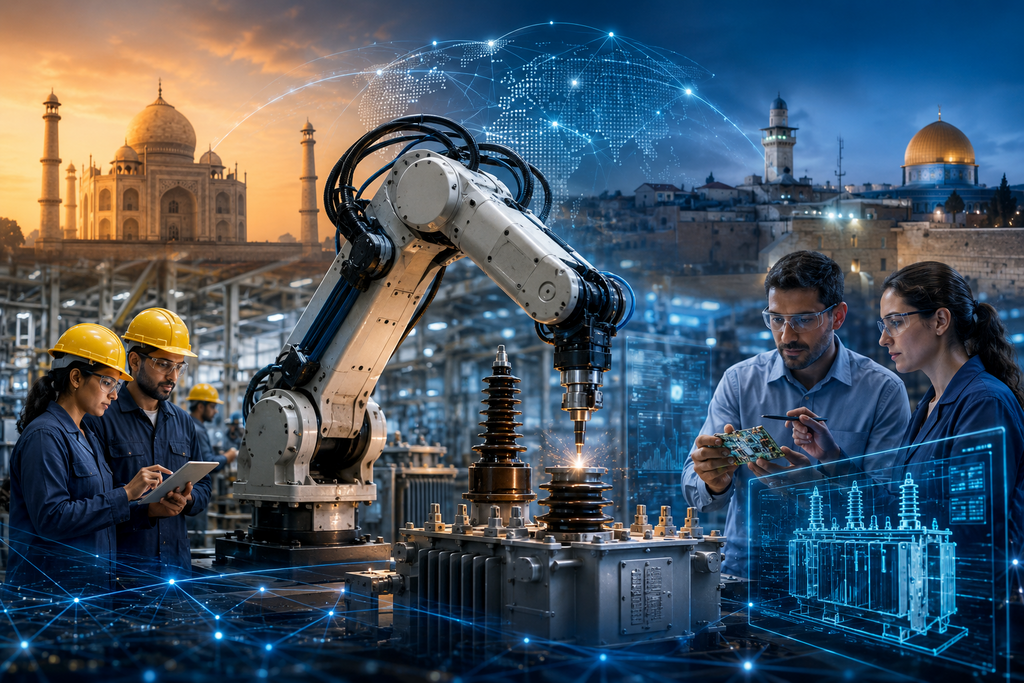
The India-Israel relationship is conventionally narrated through defense sales, intelligence sharing and agricultural technology transfer. This framing, while accurate, is incomplete. It obscures a more consequential possibility: that the two countries’ most durable strategic convergence may lie in co-developing the technologies that will define 21st-century manufacturing: heavy electrical equipment, industrial automation and robotics.
Unlike defense cooperation, which is transactional and bounded by procurement cycles, an industrial partnership of this kind would embed itself in supply chains, capital flows and workforce ecosystems on both sides, making it structurally harder to unwind and therefore more strategically valuable.
The post-pandemic and post-2022 geopolitical environment has converted what were once ordinary industrial inputs (semiconductors, robotics, grid equipment, industrial software) into instruments of statecraft. Governments are no longer optimizing supply chains for cost alone; they are optimizing for resilience and trusted partnership.
For example, a recent India’s Finance Ministry review warned that rapid advances in AI, geopolitical tensions and supply chain weaponization pose growing risks to economic stability. It urged faster policy action and structural reforms to strengthen resilience and sustain long-term growth.
This is the logic behind “friend-shoring” and behind India’s own production-linked incentive (PLI schemes) architecture across electronics, telecom equipment and advanced manufacturing.
Within this environment, India and Israel have been deliberately deepening the institutional scaffolding for economic convergence, even as regional turbulence has complicated the picture. The two governments signed a Bilateral Investment Agreement in September 2025 to protect and encourage mutual investment flows, and in November 2025 they signed the Terms of Reference to begin negotiating a comprehensive Free Trade Agreement, talks that continued into 2026, with Prime Minister Modi publicly urging early conclusion during a Knesset address.
In January 2026, the State Bank of India moved to enable rupee-based trade settlement with Israel, a modest but symbolically important step toward reducing dollar dependence in bilateral commerce. A renewed India-Israel Industrial R&D and Innovation Fund (I4F), running through 2027, continues to underwrite joint technology projects.
Yet the relationship is not frictionless. Bilateral merchandise trade (excluding defense) fell from roughly $6.53 billion in FY2023-24 to about $3.75 billion in FY2024-25, a decline both governments attribute to regional security disruptions and shipping-route interference following the escalation of conflict in the Middle East.
Some international investment funds have also reduced exposure to Israeli assets over the Gaza war. A grounded assessment of the partnership’s potential must hold both facts together: institutional momentum is real, but geopolitical volatility is a live constraint, not a footnote.
India’s industrial credentials in heavy electrical equipment are already substantial. Bharat Heavy Electricals Limited, Siemens India, ABB India, CG Power, Hitachi Energy India, Schneider Electric India, Larsen & Toubro, Havells and Bharat Electronics Limited collectively give India one of the world’s larger domestic electrical equipment manufacturing bases, supported by an extensive tier of component suppliers.
The automation and robotics layer tells a more revealing story. India’s industrial robotics market was valued at roughly $3.3-4.9 billion in 2025 depending on methodology, with most forecasts projecting 10-14% annual growth through the early 2030s; the broader industrial automation market is similarly projected to grow from roughly $3.6 billion to well over $10 billion by the mid-2030s.
India recorded a record number of industrial robot installations in 2023, ranking among the world’s top ten markets and, per the International Federation of Robotics, among the leaders in South and Southeast Asia for robot density growth. The automotive and electronics sectors account for the bulk of this demand.
The structural weakness is that this growth remains substantially import-led. India continues to depend heavily on Japan, Germany and South Korea for finished robots, and even more heavily on foreign providers for the higher-value layers sitting above the mechanical hardware: machine vision systems, servo drives, programmable automation controllers, industrial AI software and cybersecurity for operational technology.
Indian manufacturing excels at scale, assembly and increasingly at mid-tier component production; it has not yet built a comparable base in the software- and sensing-intensive layers that determine whether a factory is merely automated or genuinely intelligent.
Israel’s position is close to the inverse. Its Industry 4.0 ecosystem includes well over two hundred companies working in operations optimization, machine vision, predictive maintenance, robotics and industrial cybersecurity, a sector that has attracted sustained venture investment over the past decade.
Israeli firms such as 3D Signals have demonstrated measurable factory-floor impact, reportedly cutting unplanned downtime by digitizing production-line monitoring; firms like RGo Robotics, Kitov and Frisimos work respectively on robotic perception, AI-based visual inspection and automated cable assembly.
Industrial exports account for the large majority of Israel’s total goods exports, reflecting an economy oriented toward high-value, technology-intensive production rather than volume manufacturing.
What Israel lacks is exactly what India has in abundance: cheap industrial land, a mass manufacturing workforce, and a domestic market large enough to let a technology mature through repeated deployment. Israeli firms routinely reach a ceiling where a genuinely disruptive sensing or software innovation cannot be manufactured, deployed and iterated at the scale needed to compete globally against East Asian and European incumbents.
This is the crux of the case for convergence: India supplies scale, deployment environments and manufacturing depth; Israel supplies the software, sensing and AI layers that convert conventional equipment into intelligent infrastructure.
Neither country’s comparative advantage substitutes for the other’s; they compound. A jointly developed transformer or switchgear system embedding Israeli predictive-diagnostics software and manufactured at Indian scale is a more competitive global product than either country could build alone, and the resulting intellectual property, unlike a simple licensing arrangement, would be genuinely co-owned.
This logic applies with particular force to three sectors:
Heavy electrical equipment. India’s grid modernization and renewable energy integration programs require increasingly sophisticated protection systems, digital substations and predictive maintenance platforms, precisely the layer where Israeli industrial-AI and sensor firms have demonstrated strength, and precisely the layer that remains dominated by non-Indian multinationals within India’s own equipment industry.
Industrial automation. As Indian manufacturers face rising wage costs and export-quality certification pressure, demand is shifting from basic assembly-line automation toward AI-driven, sensor-rich systems. Co-developed platforms, combining Israeli machine vision and control software with Indian manufacturing and integration capacity, could also seed a domestic component ecosystem in servo motors, controllers and industrial communication hardware that currently barely exists.
Robotics. The next generation of industrial robots will be defined less by mechanical engineering than by perception and autonomous decision-making, which is Israel’s core competency, while India offers deployment scale across manufacturing, logistics, agriculture and infrastructure inspection that no Israeli firm could access domestically. Several dual-use applications (autonomous inspection, hazardous-environment robotics) also carry security value for both states.
The two governments already possess usable instruments: the I4F fund for joint R&D, the 2025 Bilateral Investment Agreement and an FTA process now in active negotiation. These should be extended with sector-specific mechanisms, a dedicated industrial automation and robotics innovation fund, joint standards and certification frameworks and manufacturing clusters within India’s industrial corridors that formally partner with Israeli research institutions and Technion- or Tel Aviv University-linked startups.
The India-Middle East-Europe Economic Corridor is often invoked as the connective infrastructure for such cooperation, and it retains genuine long-term logic, reducing logistics costs and creating an alternative to Suez Canal chokepoints.
But an honest appraisal must note that, as of 2026, IMEC remains in a feasibility and planning phase, with no binding financing framework, no firm construction timeline for the corridor as a whole, and its central precondition, durable Israel-Gulf normalization, significantly complicated by the ongoing Gaza conflict.
Individual national components (Gulf port and rail projects) are proceeding independently of the corridor concept. Policymakers should treat IMEC as a favourable but non-guaranteed tailwind, not as the foundation on which industrial cooperation depends. The India-Israel industrial case stands on its own economic logic even if the corridor stalls.
The strongest partnerships are rarely sustained by defense procurement alone; they endure when reinforced by industrial interdependence that neither side can easily replace. India’s manufacturing scale and Israel’s innovation depth are structurally complementary in exactly the sectors (heavy electrical equipment, industrial automation and robotics) that will determine competitiveness in the next phase of global manufacturing.
The institutional foundations for this convergence already exist and are being actively reinforced, even as regional volatility complicates trade in the near term. Building on that foundation deliberately, through joint funds, co-located manufacturing clusters and shared intellectual property, would allow both countries to become indispensable to a form of manufacturing the current global order has decided it can no longer take for granted.
-
Dr. Yashwant Singh is a sociologist who recently served as an Assistant Professor in the Department of Sociology at GITAM (Deemed to be) University, Bengaluru, India. He holds an M.Phil. in Sociology from the University of Delhi and a Ph.D. in Sociology from the University of Hyderabad, India. His research interests include urban sociology, the sociology of development and geopolitics. His writings have appeared on several digital platforms, including Across Voices, Modern Diplomacy, Geostrategic Media, South Asia Journal, World Geostrategic Insights and IA-Forum.