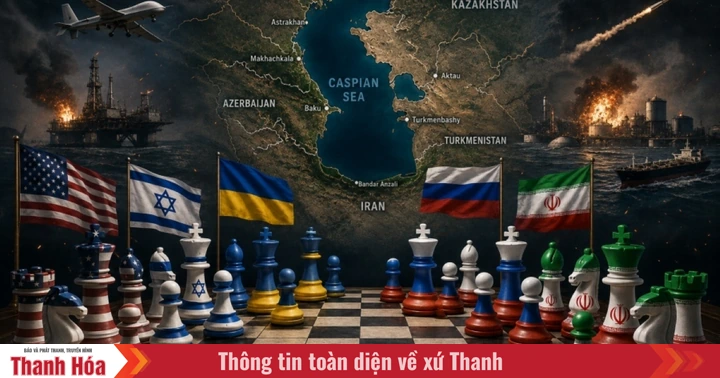

Ukraine’s recent attack on an Iranian ship in the Caspian Sea has raised concerns that Russia’s war in Ukraine and its conflict in the Middle East are becoming increasingly intertwined. Photo: Bankingnews.
The fact that US President Donald Trump hosted Israeli Prime Minister Benjamin Netanyahu and Ukrainian President Volodymyr Zelensky in Washington on the same day clearly reflects the current geopolitical reality. Two crises once seen as separate are increasingly showing signs of connection, and the Caspian Sea is where this intersection is most evident.
For many years, the Russia-Ukraine conflict has primarily revolved around the Black Sea, while the Iran-Israel tensions have been centered in the Middle East. These two conflicts exist in different strategic spaces, with distinct actors and objectives.
But that situation is changing.
First, Ukraine launched attacks on Russian oil rigs in the Caspian Sea in December. By the end of last week, Ukrainian forces expanded the operation, attacking commercial vessels that Kyiv claims serve Russian interests in the region. Meanwhile, Iran reported that one of its cargo ships had been hit, killing one sailor.

Although Ukraine has repeatedly attacked Russian ships in the Black Sea and Caspian Sea, this is believed to be the first time it has directly targeted a vessel flying the Iranian flag. Photo: Reuters.
However, Ukraine is not the only party to have brought the conflict to the Caspian Sea. In March, Israel also attacked Iranian naval forces in the Caspian Sea region, just weeks after the US and Israel launched a military campaign against the Islamic Republic of Iran.
These successive developments indicate that the Caspian Sea is gradually losing its role as a safe buffer zone and becoming a new space for military competition.
From strategic rear area to new front line
The Caspian Sea possesses a unique geographical location.
The Caspian Sea borders five countries: Russia to the north, Iran to the south, Azerbaijan to the west, and Kazakhstan and Turkmenistan to the east. Of these, Russia holds the only connection between the Caspian Sea and the oceans via the Volga-Don Canal, linking the Caspian Sea to the Black Sea – an area that has been the focal point of the Russia-Ukraine conflict since February 2022.
Conflict is nothing new to the Caspian Sea. The most recent large-scale fighting took place during the Russian Civil War in the early 20th century, a conflict that laid the groundwork for the creation of the Soviet Union after World War I. About a century before that, the region had also been a battleground between the Russian Empire and the Persian Empire.
However, in recent years, the Caspian Sea has emerged as a vital artery for Russia and Iran, two countries facing heavy Western sanctions.
For Russia, this is a crucial link to the Black Sea via the Volga River system and the Volga-Don canal. For Iran, the Caspian Sea opens a gateway to Russia and Central Asia, helping to maintain trade routes amidst numerous Western sanctions.

Via the Caspian Sea, commodities such as Russian grain and steel, along with Kazakhstan’s oil and natural gas, are transported to ports in the Black Sea basin. Photo: Banking news.
Following the outbreak of hostilities in Ukraine in 2022, the role of the Caspian Sea has increased significantly. It has become a transportation route enabling Russia and Iran to maintain military, economic , and logistical cooperation, and a link in the North-South International Transport Corridor (INSTC).
It is noteworthy that the Caspian Sea is not only a commercial shipping route but also plays a crucial role in the logistical network between Russia and Iran. Therefore, military activities in this region no longer affect only individual countries but have the potential to impact a broader chain of strategic interests. This is precisely what makes the Caspian Sea a rare intersection point between previously relatively separate conflict zones.
Conversely, the United States and the European Union place high hopes on the Trans-Caspian International Shipping Route as an alternative to trade routes through Russia. This means that any disruption in the Caspian Sea no longer only affects Russia or Iran, but directly impacts the economic and energy strategies of many other countries.
Therefore, the Caspian Sea today is not simply an inland sea. It has become a strategic crossroads where the interests of Russia, Iran, Europe, the United States, China , and Central Asia converge.
The worrying thing is not an attack.
Recent attacks may not be enough to create a military turning point.
What concerns analysts more is the trend of expanding the scope of warfare.
For many years, the two largest current conflicts operated almost independently. Ukraine focused on confronting Russia, while Israel and Iran clashed on the Middle Eastern front.
However, when the objectives of Russia and Iran are present along a strategically important logistical route like the Caspian Sea, the boundaries between the two conflict zones begin to intersect. This doesn’t necessarily mean the two wars have merged, but it shows they have the potential to influence each other more than before.
In the event of continued escalation of tensions or new retaliatory actions, the scope of the conflict could expand to strategic areas that were previously less directly affected. Conversely, if Israel continues to target Iranian military or logistical facilities around the Caspian Sea, the region will become a place where two major conflicts coexist in a single strategic area.

Iranian-made Zolfaghar missiles are displayed in Azadi Square in Tehran. Photo: AFP.
This scenario has led many experts to begin discussing the possibility of forming an “Eurasian conflict system,” in which developments in Eastern Europe and the Middle East are no longer separate wars but increasingly influence each other.
A military event in the Caspian Sea would therefore no longer only affect Moscow or Tehran, but could trigger chain reactions from Kyiv, Tel Aviv, Washington, and even Central Asian countries.
A “new Hormuz” for the Eurasian continent?
For months, the Strait of Hormuz has been the focus of global attention due to the risk of disruption to global energy supplies.
The Caspian Sea is rising again in a different way.
If the Hormuz dictates the flow of oil, the Caspian Sea is increasingly determining the ability to maintain logistical networks between Russia and Iran.
This is not just a freight transport route.
It also serves as a bridge for Russia to receive various equipment, components, and goods under sanctions; it is a trade route that helps Iran maintain connections with Russia and Central Asia; and it is a crucial link in trade corridors that Europe hopes will diversify its sources of energy and strategic minerals.
In other words, if the Hormuz is the world’s “energy valve,” then the Caspian Sea is gradually becoming the “logistical valve” of the Eurasian continent.
Therefore, any instability here risks creating ripple effects on supply chains, trade, transportation, and regional security.
The Caspian Sea will be a new test of geopolitics.
It is too early to conclude that the two wars have merged into one larger conflict.
However, what is happening in the Caspian Sea shows that the map of global conflict has begun to change.
Modern wars are no longer confined to borders or traditional battlefields. They are increasingly expanding into logistics routes, trade corridors, energy infrastructure, and international transportation networks.

The Caspian Sea is no longer a body of water completely isolated from surrounding conflicts. Photo: Timesnownews.
The Caspian Sea is the clearest evidence of that trend.
If the parties continue to view the Caspian Sea as a military target aimed at disrupting each other’s supply lines, the world’s largest inland sea could lose its role as a strategic buffer zone and become a new front of geopolitical competition.
At that point, what the world would face would not just be a new hotspot on the map, but the intersection of two wars that had previously existed in parallel. And once those lines are blurred, the risks to regional security, international trade, and the Eurasian order would be far greater than the impact of any single attack.
Thuy Ha
Source: https://baothanhhoa.vn/bien-caspi-noi-song-khi-hai-cuoc-chien-lon-nhat-the-gioi-tim-thay-diem-giao-thoa-296529.htm

