
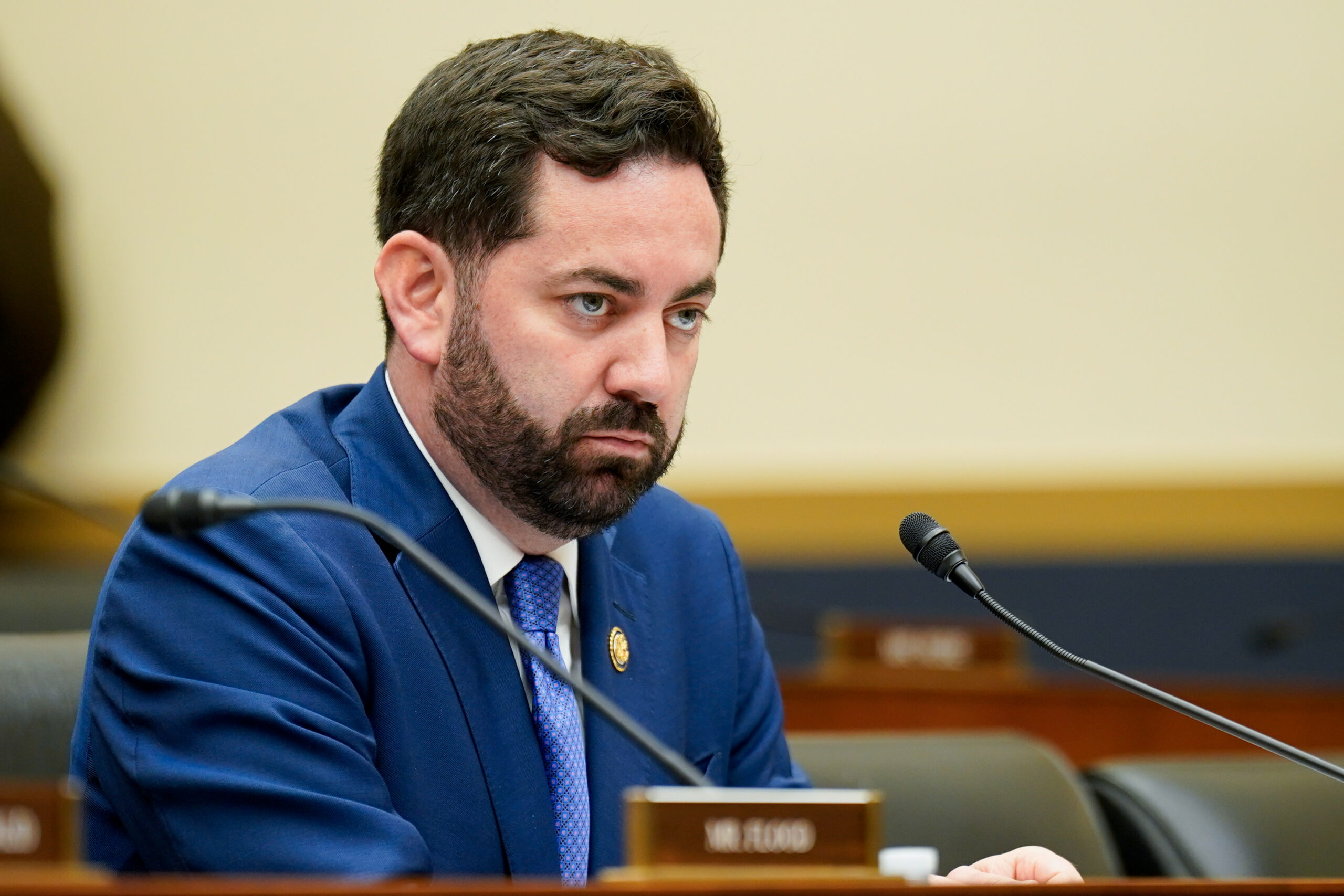
Rep. Mike Lawler (R-NY), the top Republican on the House Foreign Affairs Committee’s Middle East subcommittee, insisted at a Wednesday hearing that Israel could not be excluded from the India-Middle East-Europe Corridor, and called out U.S. Ambassador to Turkey Tom Barrack for apparent efforts to advance an alternative trade corridor through Syria.
The hearing was called to focus on efforts to expand the Abraham Accords. The IMEC corridor, a proposed regional trade route that would connect Europe to India through Israel, Saudi Arabia and other Middle Eastern nations, was repeatedly raised by witnesses and lawmakers as a key next step in expanding existing normalization agreements and moving toward future ones.
“Unfortunately, reporting came out recently that anonymous Saudi officials were considering connecting these two countries through Syria instead, and just the other day it came out that Ambassador Barrack out in Turkey was also supporting this,” Lawler said. “In my mind, that is unacceptable.”
Barrack last week announced and promoted plans for a Middle East trade route through Iraq, Turkey and Syria.
Lawler previously wrote to Secretary of State Marco Rubio asking him to ensure that Israel remains part of IMEC.
Former U.S. Ambassador to Israel Dan Shapiro, now a senior fellow at the Atlantic Council, noted in his testimony that Iran’s ongoing closure of the Strait of Hormuz highlighted the potential value of the IMEC corridor.
Former U.S. Ambassador to Israel David Friedman said that the IMEC corridor would be “integral to a more peaceful and cooperative Middle East” and was dismissive of the idea that a pipeline through Syria could be a practical solution in the near-to-medium term, given the recent and continued instability in the country.
He argued that the pipeline should run through the West Bank as a job-creation opportunity for Palestinians that he said would help advance the prospects of peace.
Asher Fredman, the executive director of the Misgav Institute for National Security, said that even short of full Saudi-Israeli normalization, there were ways that the IMEC corridor and Saudi-Israeli ties could be advanced, such as allowing the transit of goods to or from Israel though Saudi Arabia, similar to how Saudi Arabia permitted airlines to fly over Saudi territory going to and from Tel Aviv beginning in 2022.
Highlighting and advancing such steps that serve Riyadh’s own interests could be a way to expand ties and move in the direction of normalization even short of an immediate agreement, Fredman said.
Witnesses and lawmakers also emphasized the importance of appointing a dedicated special envoy for the Abraham Accords, an ambassador-rank position established by Congress that neither the Biden nor Trump administrations have filled.
Shapiro also called on the administration to fill ambassador and other senior diplomatic posts in the region that the Trump administration has left absent while vesting significant responsibilities in envoys including White House Special Envoy Steve Witkoff and Jared Kushner.
The former Biden administration official told lawmakers that efforts to normalize Saudi-Israeli relations had continued even following the disruptions of the Oct. 7, 2023, Hamas attacks on Israel, which would have been paired with an end to the war in Gaza and a release of hostages.
He said that Saudi demands for a component related to advancing a two-state solution have also remained consistent — repeatedly referencing comments to that effect by former Sen. Lindsey Graham (R-SC), who had long worked on Saudi-Israel normalization.
President Donald Trump announced the morning after the hearing that a new civil nuclear cooperation agreement between the U.S. and Saudi Arabia is “totally subject” to Riyadh joining the Abraham Accords. Shapiro and Democratic lawmakers had criticized the administration for reportedly inking that ideal without connecting it to normalization, but Friedman suggested there might be more at play that had not been reported.
Friedman argued that Saudi Arabia’s core security interests in normalization, for the purpose of countering Iran and its proxies, remains the same. And he emphasized that no new Israeli government is likely to take a more positive stance toward a two-state solution, highlighting widespread support among the Palestinian population for Hamas and the Oct. 7 attacks.
Friedman said that other countries won’t be interested in pursuing normalization without a durable, bipartisan U.S. consensus in support of Israel, which he said is slipping on the extreme fringes of both parties.
“These countries are watching this every single day. … Until we know who we are, where we stand as a country with regard to Israel, no one’s going to take a gamble,” Friedman said.
Rep. Brad Schneider (D-IL), a founder and co-chair of the House Abraham Accords Caucus, also warned that politicization of the U.S.-Israel relationship at home is counterproductive to the cause of normalization.
“We risk squandering the opportunity to help lead the region of the Middle East — critical to the United States — we risk squandering the opportunity to lead them to a more stable, secure, prosperous and, ultimately, more peaceful future,” Schneider said. “We have to be united in our commitment to that vision of regional integration, the vision of a safe and secure Jewish democratic state of Israel, living collectively integrated with the 21 Arab [states], the states of the Arab League, and the Palestinians and their aspirations to self-determination and peace with Israel.”
Shapiro repeatedly warned that the Iran war is a major stumbling block toward further normalization, arguing that the conflict is making Gulf states doubt their long-term alliances with the U.S. and see Israel and, to an extent, the U.S. as destabilizing actors. He said that further Israeli action against violent settlers in the West Bank would also be an important step.
Friedman said that settler violence should be opposed but argued that the scope of the problem has been significantly overstated and Palestinian violence in the West Bank has been overlooked.
In the wake of the Oct. 7 attacks and the ensuing war in Gaza, Shapiro argued that Arab publics in the region are less interested in normalization, and the Israeli public has likewise grown more aggressive toward potential security threats, neither of which are conducive to further normalization.
But he pointed to the governmental changes in Syria and Lebanon as providing opportunities for normalization.
Rep. Debbie Wasserman Schultz (D-FL), another co-chair of the Abraham Accords Caucus, warned that the Accords currently lack grassroots buy-in and also emphasized the need to work to maintain and strengthen the current agreements, in addition to looking for ways to expand them. She criticized moves by the Trump administration to cut funding for people-to-people peacebuilding programs.
Fredman laid out a multi-point strategy for expanding the Accords, which received praise on both sides of the aisle, including advancing IMEC, pursuing a coordinated roadmap and strategy to advance projects and other economic harmonization efforts, advancing technology and security partnerships and pursuing people-to-people connections through expansions of existing U.S. scientific, leadership and education programs.
