
- UK should be part of the ‘strong international move’ for tougher measures against trade linked to illegal Israeli settlements, Thornberry tells Anadolu
Britain should move much faster to sever economic links with illegal Israeli settlements in the occupied West Bank and align itself with a growing European push against settlement trade, according to the chair of the UK Foreign Affairs Select Committee, who believes the country’s incoming leadership has an opportunity to take a firmer stance.
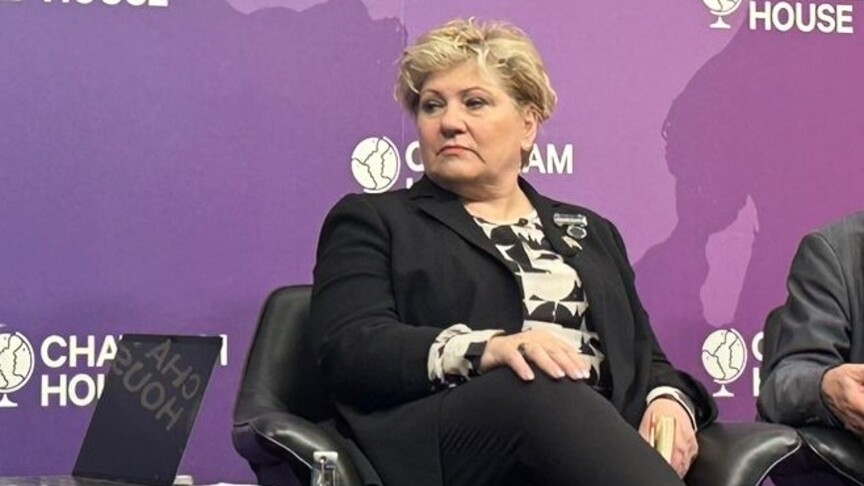
Speaking to Anadolu in Westminster, Emily Thornberry urged the next prime minister, widely expected to be Andy Burnham, to ensure Britain provides no financial or commercial support to settlements that she says are entrenching Israel’s occupation and undermining the prospects of a Palestinian state.
Burnham is set to be confirmed as the next Labour Party leader on July 17, and would officially take over as prime minister from Keir Starmer on July 20 after a meeting with King Charles III.
“My advice, if Andy Burnham wanted to hear it, would be that we should be … moving much faster to find a way in which we can ensure that we do not put any money, any resources, any insurance, any finance, any goods, anything to help with the (illegal Israeli settlement) development in the West Bank, and we buy no goods from the West Bank,” said Thornberry.
Her comments come as Israel presses ahead with plans to expand settlements in the strategically significant E1 corridor, a move widely viewed internationally as one of the biggest threats to the viability of a future Palestinian state.
The roughly 12-square-kilometer (4.6-square-mile) area lies between occupied East Jerusalem and the illegal Israeli settlement of Ma’ale Adumim. Israel plans to build thousands of new housing units and supporting infrastructure, which Thornberry views as a direct, hostile retaliation to the growing international recognition of a Palestinian state.
Growing pressure over illegal Israeli settlements
Thornberry said international patience over the expansion of illegal settlements is rapidly wearing thin, particularly as concerns mount over Israeli actions in both Gaza and the occupied West Bank.
She argued that Britain should join countries including the Netherlands, Ireland, Norway, Spain and Belgium, which are pursuing tougher measures against trade linked to settlements.
“I’ve seen many countries starting to look at how to ensure that we don’t put services or goods into the West Bank. We don’t support the annexation of the West Bank, the snuffing out of Palestine, as ministers have said,” she added.
“That is what the settlement program is and we need to do something about it.”
According to Thornberry, international law provides a clear basis for such action.
She pointed to the International Court of Justice’s advisory opinion, saying the global community must “abstain from entering into economic or trade dealings with Israel concerning Occupied Palestinian Territory.”
“There is a strong international move to do that, and I think that Britain should be part of it.”
She also added that Britain already distinguishes between Israel and the occupied territories through its existing trade arrangements.
“It should be possible. We have a trade deal with Israel where we have preferential treatment of goods coming from Israel, but not from the West Bank.”
Burnham’s evolving position
While Thornberry said she could not predict the approach of an incoming Burnham government, she noted that his views on Israel and Palestine have evolved over time.
Historically, Burnham largely aligned himself with mainstream Labour Party policy. During the party’s 2015 leadership contest, he said his first overseas visit as Labour leader would be to Israel and joined Labour Friends of Israel.
He also criticized the Boycott, Divestment and Sanctions (BDS) movement as “spiteful.”
At the same time, he consistently backed a two-state solution and opposed illegal Israeli settlements, including during a visit to the occupied West Bank with pro-Palestinian lawmakers in 2012.
His position shifted further after the outbreak of Israel’s genocidal war on Gaza war. In October 2023, as mayor of Greater Manchester, he broke with Labour’s national leadership by calling for an immediate ceasefire, and in 2025 co-signed a letter urging formal British recognition of a Palestinian state. More recently, he has voiced concern over what he described as the “disproportionate nature” of Israel’s assault on Gaza.
Last Thursday, Burnham apologized for Labour’s initial response to Israel’s war on Gaza, promising a tougher approach toward the Israeli government if he becomes prime minister.
Speaking to The Guardian, Burnham acknowledged concerns over Labour’s handling of the Gaza conflict and said the party needed to “do better.”
“I know many people feel that at the start of Israel’s military action in Gaza, my party didn’t get it right, and I am sorry about that. The response has too often not been good enough. We need to do better,” he told The Guardian.
‘We missed an opportunity’
Thornberry also reflected on what she believes was a missed diplomatic opening following US President Donald Trump’s election, arguing that his influence over Israeli Prime Minister Benjamin Netanyahu could have been used to advance a broader Middle East peace initiative.
“I wasn’t overwhelmingly happy when Donald Trump was elected … But it seemed to me that one of the things that could be a positive was that he certainly had strength and he could be presented with a plan, saying, ‘If you really want a peace prize, this might be a way you could do it.’”
She said a group of influential countries that have “an authority almost in the region” could have worked together to build momentum for such an initiative.
However, she said, the international focus shifted to the Russia-Ukraine war.
“Instead, what happened was Ukraine, and so all that authority and power was instead used on trying to persuade Trump to not pull out of Ukraine … We missed an opportunity.”