
Huitong Network July 6 News—— Israel’s inability to expand the war benefits US-Iran negotiations, easing rate hike constraints, and dual dividends from geopolitics and recession continue to support gold in the medium and long term.
On Monday (July 6) during Asian and European trading hours, spot gold experienced a spike followed by a pullback, currently trading near 4156, down 0.43%. Recent geopolitical shifts provided an opportunity for a rebound, and weaker-than-expected non-farm payroll numbers injected further momentum.
On July 5, Israel’s cabinet voted to reject a Supreme Court ruling related to media regulation, openly defying the Supreme Court for the first time.
This action was met with a barrage of criticism from the president, multiple former prime ministers, Netanyahu’s current rivals, opposition parties, and journalists’ associations, who accused Netanyahu’s government of “crossing the red line.”
Meanwhile, the rift in the US-Israel alliance continues to deepen. Prime Minister Netanyahu has long since lost the operational room to expand the conflict with Lebanon, as a multitude of internal and external constraints jointly limit further military escalation.
Domestically, Netanyahu is deeply embroiled in corruption lawsuits and faces imminent imprisonment. With national elections looming this year, the opposition is focused on attacking his diplomatic failures and the dwindling support from the US ally.
Ongoing warfare continues to drive up military spending and soldier casualties, with anti-war sentiment among the domestic population intensifying,
meaning the marginal benefits of consolidating his political base through hardline military actions have long since turned negative. Further escalation can only accelerate his political collapse.
The United States Turns to Negotiations with Iran, Targeting Midterm Elections
Externally, the United States’ attitude has fundamentally shifted. Recently, recorded calls between Trump and Netanyahu were leaked,
with Trump openly berating Netanyahu for insisting on war, and Vice President Vance highlighting that two-thirds of Israel’s defense equipment relies on US funding, applying sustained pressure on Israel to halt their Lebanon offensive.
Iran has made a permanent Lebanon-Israel ceasefire the non-negotiable precondition for talks with the US. To secure diplomatic achievements in the Middle East and avoid large-scale regional conflict and energy-driven inflation, the Trump administration no longer allows Israel uncontrolled military expansion, cutting off Israel’s core external support for escalating the war.
From Netanyahu’s perspective, the window for Israel to lock in gains in Lebanon was missed back in April and May. Now, increasing military stakes is a contrarian, high-risk move with the potential for unlimited losses;
Passive stalemate in hopes of a turnaround only accumulates further costs. The optimal choice is to contract the front lines, lock in existing tactical gains, and no longer seek all-out war expansion.
The easing of geopolitical risks directly removes a core barrier to US-Iran negotiations, and the market’s expectation for a phased agreement between the two sides has continued to heat up.
Once the Lebanon-Israel conflict cools and Iran’s core demands are met, the US and Iran can advance substantive negotiations on nuclear restrictions, the navigation of the Strait of Hormuz, and the unfreezing of overseas assets;
The risk of energy transport channel blockades is removed, international oil prices continue to fall, energy-driven global inflationary pressure simultaneously declines, the core rationale for continual Fed rate hikes is weakened, and the outlook for a shift in monetary policy is gradually priced in.
Regional Conflict Eases But Risks Remain, Global Arms Race to Persist Long-term
There has recently been a sharp drop in ships passing through the Oman Channel
, and during Friday and Saturday, at least eight vessels suddenly changed course while crossing the Oman Channel, with four subsequently rerouting via the Iranian side.
No official explanation has been given, but Iran has repeatedly stated that ships are only allowed to navigate authorized and designated routes.
According to Kpler data, a total of 19 ships transited the strait in both directions on Saturday, but only one publicly declared it entered via the Oman Channel, compared to 13 the previous day. This Iranian dominance over the strait may soon be challenged by the US.
The recent moderation of Middle East hostilities only signals a decrease in regional risk, but on the global scale, the arms expansion of major nations and regional arms races show no sign of stopping, and the fundamental logic of geopolitical hedging has not vanished.
On one hand, Middle Eastern countries continue to expand their air defense and long-range strike capabilities for their own security, with Iran and Saudi Arabia accelerating both indigenous weapons development and overseas procurement, keeping regional military investment at elevated levels;
On the other hand, the world’s major economies are continually ramping up conventional weapons, AI military technology, and missile defense systems. Central banks and governments, driven by geopolitical hedging, are further diversifying foreign exchange reserves, reducing US dollar assets, and increasing gold holdings for strategic risk mitigation.
Regional conflict merely experiences a temporary cooling, while great power competition and arms races are structural medium-to-long term trends. Occasional skirmishes, targeted strikes, and disruptions to shipping will recur, meaning the geopolitical risk premium will not fully disappear from markets, and gold will continue to retain its fundamental value as a hedge against unexpected geopolitical crises.
Macroeconomic Logic Restructured: Gold Breaks Free from Inflation and Rate Hike Constraints, Dual Dividends Sustain Price
In the past, escalation in the Middle East would form a chain of negative transmissions suppressing gold: conflicts push up oil prices→energy inflation surges→markets reinforce expectations for continued Fed rate hikes→US real bond yields rise, lifting the holding cost of non-yielding gold assets, and safe-haven logic is offset by tightening expectations.
But now, Israel’s inability to escalate the war and improving US-Iran negotiations have completely reversed this pricing mechanism, providing gold with a logical rebound.
First, gold has temporarily broken free from the dual pressures of global inflation and rate hikes. Second, the easing Lebanon-Israel conflict has dragged oil lower, significantly softening energy inflation stickiness. The market is downscaling expectations for the Fed’s continued rate hikes and for long-term high interest rates. US real bond yields are trending lower, greatly easing the valuation pressure on gold;
The previously constraining issue of gold’s opportunity cost has improved, and gold is no longer continuously suppressed by the tightening cycle.
Currently, gold continues to enjoy two major tailwinds.
The second is the recession-hedging dividend: the US labor market has weakened more than expected, downside risks to the economy are emerging, global debt is high, and domestic consumption is weak. Markets are preemptively trading for a rate-cut cycle. As a hard currency able to withstand recessions across cycles, gold is well positioned to absorb both safe haven and allocation capital.
Summary and Technical Analysis:
Double constraints—internal and external—on Israel make it difficult to expand regional war any further. Optimism about US-Iran peace talks is mounting, and the drop in energy inflation has eroded the need for further Fed hikes. Gold has been freed from the prior bind of inflation and high rates.
Coupled with persistent geopolitical hedging demand from the global arms race, as well as a recession buffer provided by weaker-than-expected US non-farm numbers and global recessionary expectations, gold is forming a “easing rate pressure + geopolitical premium base + recession allocation” threefold benefit, offering structural medium-to-long term upside potential.
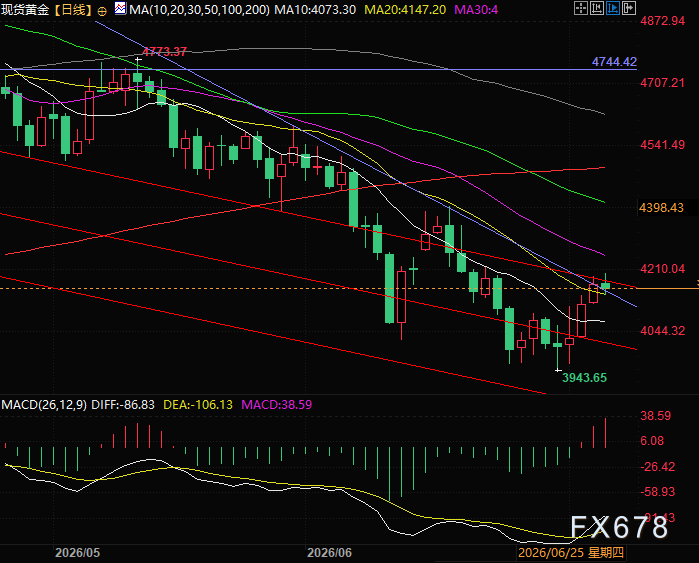
Technically, gold is currently fluctuating under pressure at the downward trend line and the upper boundary of the channel, perfectly matching the resistance zone identified in previous articles. After the recent upward move following a downward trend, prices are prone to retrace. Attention should be given to future long entry opportunities.
(Spot gold daily chart, source: EasyHuitong)
As of 16:02 Beijing time (UTC+8), spot gold is quoted at 4162 USD/oz.

