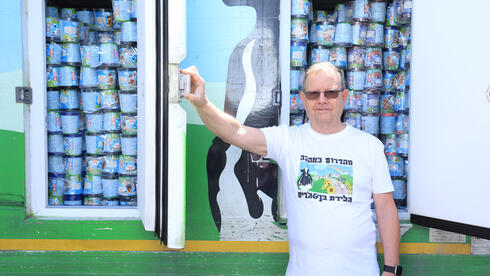
At the time, Ben & Jerry’s was an emerging ice cream empire with annual revenue of $270 million—today it exceeds $1.3 billion. My hosts at the offices, factory and “ice cream cemetery,” where discontinued flavors rested, were founders Ben Cohen and Jerry Greenfield. Though they sold control to Unilever (today owning 19.9% of the brand), they remained involved. The Israeli licensee, Avi Zinger, connected the trio, and thanks to him, I was able to interview the reclusive founders. “We had a fantastic relationship. My family visited them twice a year, and I brought Ben and Jerry to Israel,” Zinger recalls. “They always used me as an example of someone who maintained both product quality and core values. I saw them as my center of life.”
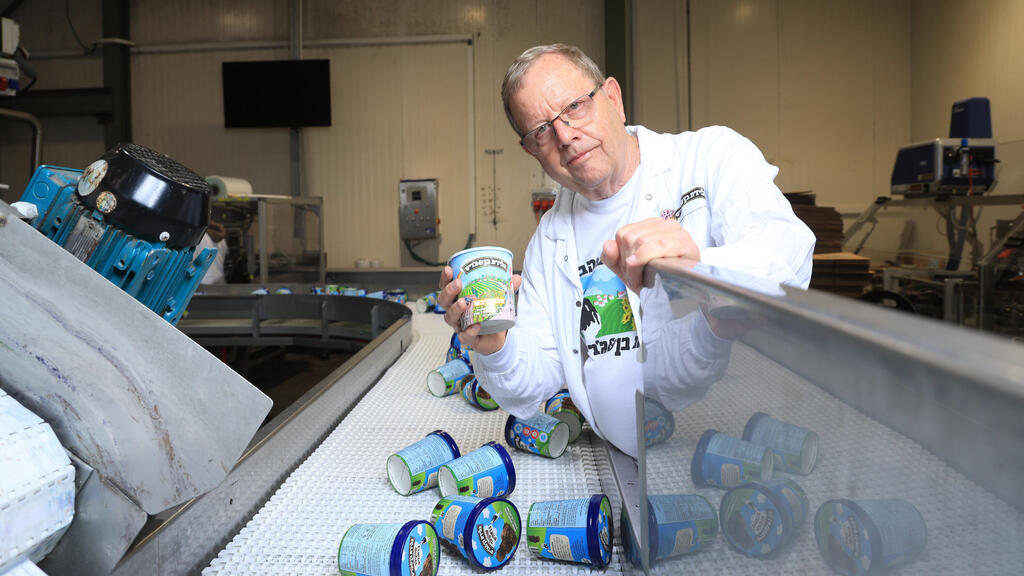
None of us imagined that this friendship and those whimsical ice cream flavors would become the target of one of the most aggressive boycotts against Israeli products—sparking an unprecedented legal, business and political battle. Zinger fought the brand he had represented for years and ultimately won, acquiring the rights to independently produce and sell Ben & Jerry’s in Israel and the territories. He declines to reveal the price. “We’re a private company,” he says. “Thankfully, the end result is the best I could have hoped for. I kept everything I love.”
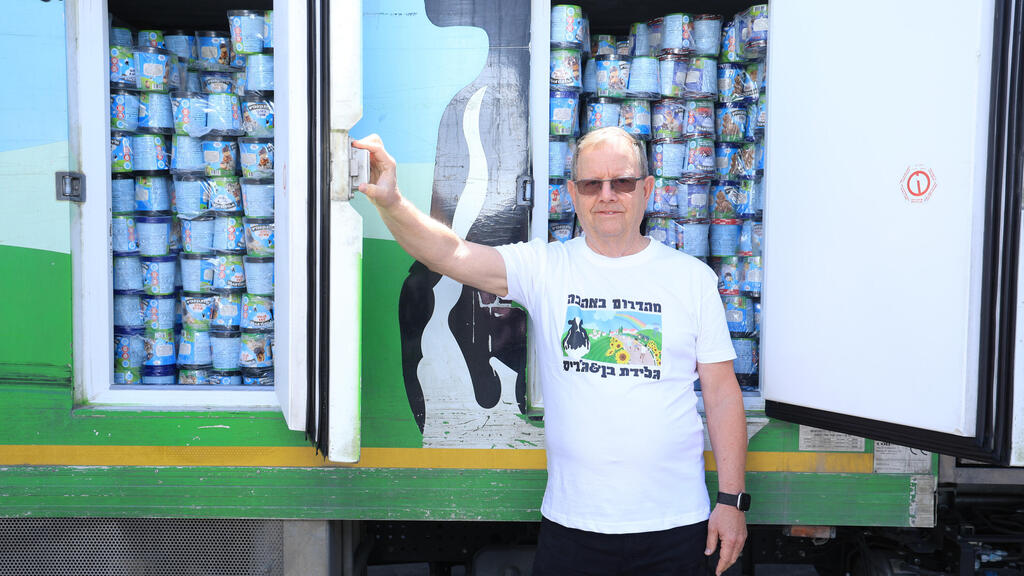
Israel’s ice cream market is valued at 1.3 billion shekels annually, with 50% coming from impulse purchases at kiosks, convenience stores and beaches; 35–37% from retail chains, and the remainder from institutional sales. The largest segment in retail is family-sized ice cream, with Ben & Jerry’s accounting for over 50% of sales. The company generates roughly 220 million shekels annually in Israel, employing around 200 workers, mostly at the Be’er Tuvia factory. Approximately 130 million shekels will be invested in a new facility in Kiryat Gat, set to open in 2029.
Zinger, who was once a New York student and Israeli consulate employee, admits his success almost slipped away due to the BDS battles. “Even today, I’m the type who can oversee a pint box and manage production myself. The best ice cream, in my view, comes straight off the production line,” he says.
Zinger discovered Ben and Jerry, childhood friends born four days apart in Brooklyn, in 1983 during a ski trip in Vermont. He first tasted their ice cream at the gas-station shop they opened in May 1978. Their success was driven by unusual ingredients and bold choices, like oversized chocolate chunks, strong flavors and unconventional combinations—Ben insisted on these, despite production challenges. They were also the first to mix savory bagels into ice cream, notes Zinger.
5 View gallery
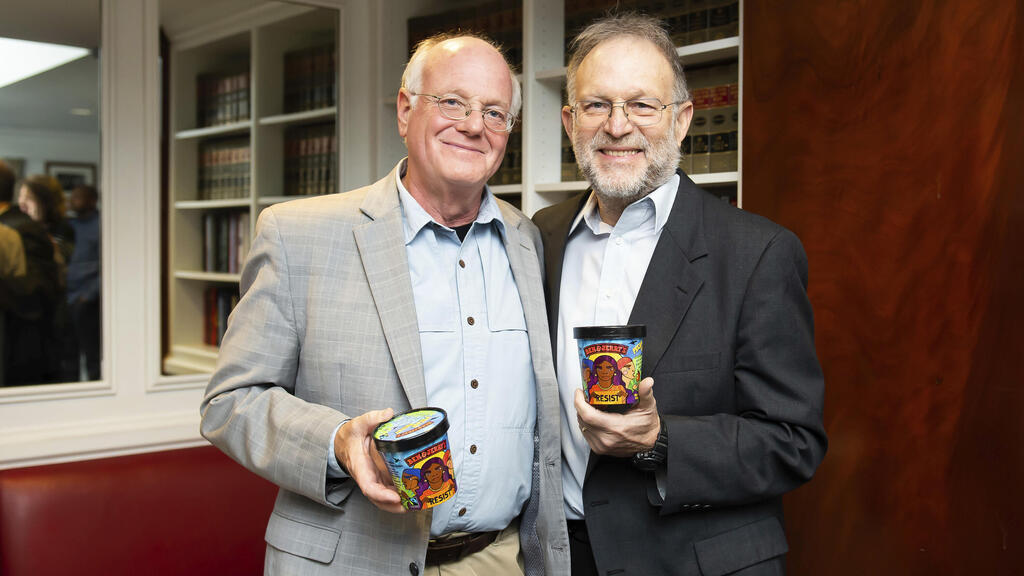
Ben Cohen and Jerry Greenfield, founders of the American ice cream brand ‘Ben & Jerry’s’
(Photo: Joy Asico/AP)
“I met them through my brother, in Ben’s Brooklyn studio apartment. I admitted I didn’t know much about ice cream, but wanted to produce it in Israel and buy the equipment. They asked if Israel had milk and eggs, and when I said yes, they connected me to their lawyer in Ithaca, seven hours from New York. Negotiations dragged on for a year. My lawyer eventually finalized the agreement, including 3% royalties. For the early years, I paid nothing due to financial hardships.”
The agreement also required contributions to social initiatives. “Ben & Jerry’s Israel funded many projects, including coexistence initiatives, and upheld the brand’s values,” Zinger says.
Zinger entered Israel with a single ice cream shop in Dizengoff Square in 1987, expanding to 16 locations by 2000. The intifada heavily affected sales. His breakthrough came when Mordechai Krayner, former VP of Shufersal, tasted the ice cream and demanded exclusive distribution in the chain. A year later, Zinger expanded into “Blue Square Co-op,” and the rest is history.
In 2000, Cohen and Greenfield sold the company to Unilever for $350 million. The original agreement granted the board unusual independence in promoting social missions and maintaining brand integrity—a clause that later caused headaches. “Bernie Sanders, a progressive Jewish senator critical of Israel, is a friend of Ben and Jerry, and they built that relationship. For ten years, I saw trends limiting my Israeli sales. The company was always mine, operating under a local license, not a restrictive franchise,” Zinger recalls.
In July 2021, the independent board, chaired by Anuradha Mittal, demanded Ben & Jerry’s Israel stop selling products beyond the Green Line, yielding to BDS pressure. “Mittal was a friend. I thought we had mutual respect.”
Friend? By December 2023, after Zinger acquired the Israeli rights, she tweeted for the U.S. to stop arming Israel over alleged war crimes.
“I have nothing to do with her. I don’t know what’s happening. It’s just absurd.”
The controversy caused confusion among Israeli consumers, who mistakenly blamed Zinger for the BDS-driven decision. “Refrigerators were broken in Eilat, people thought I was an enemy of the state. Even customers in settlements called to boycott Ben & Jerry’s Israel, accusing me of supporting Hamas.”
Zinger went into media overdrive, giving nonstop interviews locally and internationally to clarify he had no connection to the decision. “I suddenly became a media star worldwide—Fox, Bloomberg, CNN—all wanted interviews. I just wanted to explain it wasn’t me.”
When asked about recent boycotts of other Israeli products in the U.S., like Eco Love shampoo, he advises: “Immediately contact Jewish organizations in New York. This could become a slippery slope, affecting kosher food. Use all legal avenues. The Jewish lawyers who helped me were fantastic. No Israeli can handle this alone.”
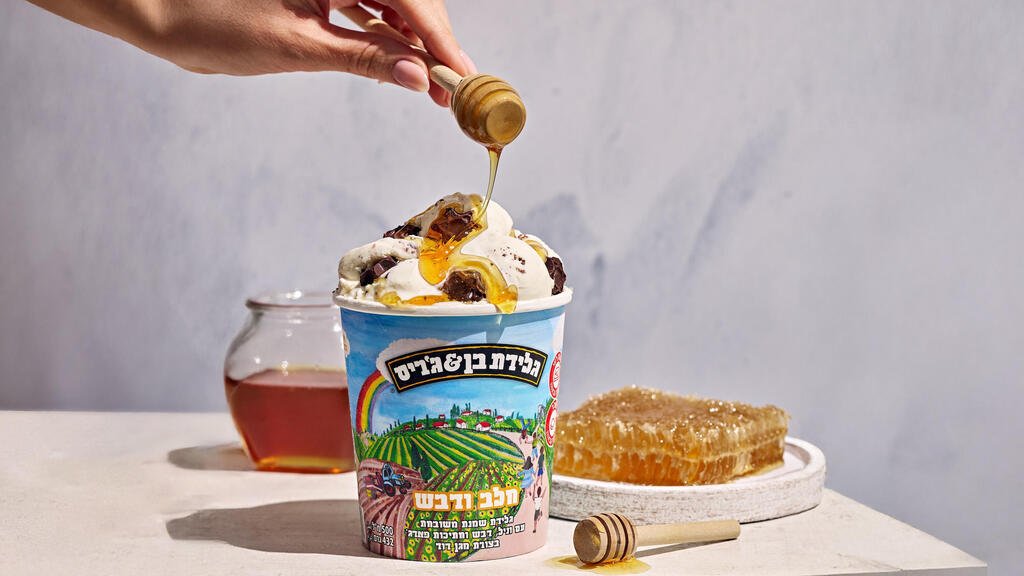
As part of a personal closure, Zinger is launching the “Milk & Honey” flavor, honoring border communities whose farms were impacted on October 7. Most ingredients, including milk and cream, come from these communities. Honey comes from Mordechai, and the fudge, shaped like a Star of David, is produced by “Sh’kulo Tov,” employing workers with disabilities in Be’er Sheva. Due to production limits, the flavor will be released in limited packaging. The illustration, “Fields of Light,” is by the late artist Rivi Gerloy-Doron from Moshav Esboul.
“3–5% of sales,” explains Zinger, “will go to the Eyalim association, encouraging students to establish communities in the north and south. That’s why the packaging emphasizes ‘From the South, with Love’ and ‘From Ben & Jerry’s Israel to You.’”
Will “Milk & Honey” be a hit?
“It has exactly the flavors Israelis love. People want to indulge in a premium product with a purpose. In post-October 7 Israel, if the goal is to strengthen the country, this works especially well.”

In retrospect, Avi Zinger’s struggle proved financially worthwhile. Apart from the first year, when sales dropped roughly 20% due to consumer and distributor confusion—many mistakenly believed the boycott of sales in the West Bank was his decision, not the international company’s—sales have since risen and, by his account, exceed 2021 levels.
Zinger’s media blitz during the controversy—interviews and explanations positioning him as the “good guy” in the story—paid off. He began receiving widespread public support that continues today. Israeli tech companies hosted “happy hours” with Ben & Jerry’s ice cream, young people bought kilos for parties, and hundreds of cyclists staged a demonstration near the Be’er Tuvia factory. Ninety members of Knesset, excluding Arab parties and Meretz, signed a letter criticizing Unilever. It became a kind of national struggle.
“Endless organizations in Israel mobilized for the cause. Not to mention Jewish communities in the U.S., which sent thousands of letters to senators. In 33 U.S. states, laws against BDS exist, and lawsuits were filed. I also filed a case in federal court in New Jersey, claiming the boycott violated American law,” he recalls.
“Not for a moment. I took it personally. I’ve spent years building the brand, employing nearly 200 people, supporting farmers supplying milk, and countless others who would be affected. These were two extremely hard years.”
The hardest period? “At the start, before the board issued its official letter, there were one or two weeks when I tried to stop it. I couldn’t believe it would happen—everyone was my friend.”
Did you ever consider changing the brand name in Israel?
“My biggest fear was that people would think these weren’t Ben & Jerry’s products. It was crucial to me that they knew these were the real products. If I had stopped using the name, that would have been the BDS victory. I wanted people to know I was selling the products in Israel and could do so freely. Commercially, it mattered—after all, I built the brand in Israel for 35 years independently of the U.S.”
Zinger successfully convinced Unilever to sell him the rights to the brand in Israel and the territories, gaining full control while Ben & Jerry’s lost it.
“For the past three years, I’ve been legally and formally disconnected from them. I have no obligations beyond maintaining brand values and ingredient quality—requirements that align with my own interests. I follow new Ben & Jerry’s flavors, open to formulas and successes. I know the market, understand consumer trends. Thirty years ago, peanut butter was niche; today it’s mainstream.”
What about the so-called “Palestinian ice cream” (a red-and-green watermelon sorbet) Cohen introduced last year?
“That ice cream doesn’t exist. There’s a video of someone in a kitchen mixing ice cream, and then people say Ben & Jerry’s made a Palestinian flavor. There’s nothing there. Every six months, there’s a new conflict. I’ve completely moved on.”
Do you have rights to sell in the Palestinian Authority?
“Not yet. Waiting for Trump,” he quips.
Zinger also faces operational challenges, like staffing. “One difficulty is finding workers. For a driver earning 15,000–20,000 shekels, the hiring process is tough. We started employing foreign workers, but because we don’t hire them directly, it’s very costly—90 shekels an hour—and integrating them isn’t easy.”
And consumer prices? Ben & Jerry’s pints retail between 15.90–29.90 shekels, a gap of 88%. Frustrating for customers.
“I can’t control someone charging 29.90. I heard a pint was sold at the Dead Sea for 40 shekels. The high price bothers me because consumers blame the brand, not the retailer. During the boycott, we were the only ones not raising prices. In winter 2025, we raised prices 3–4% on average, still cheaper than Europe or the U.S. There are crazy promotions too. For example, Osher-Ad sold pints for 11–14 shekels per pack.”
A weaker shekel allows for price absorption. “A falling dollar helps offset wage and electricity increases.”
Zinger, who started in Dizengoff Square in September 1989 and expanded to 16 stores, now runs only the Be’er Tuvia and Gan Yavne locations in Israel. Worldwide, including the U.S., Ben & Jerry’s has many “Scoop Shops.” Israel has over 500 ice cream shops and 20-plus chains.
Will you expand internationally?
“Not right now. Ice cream stores are great, but you need to be deeply involved. A single rude clerk can harm the brand. We have many activities demanding attention—from production to management to distribution, including Ben & Jerry’s export. I won’t open franchises—it doesn’t suit me.”
Why no diet ice cream?
“We tried lowering fat content but abandoned it—it didn’t work. We are working on oat-based vegan ice cream and hope to launch soon, not this summer due to complex production requirements and insistence on 100% natural ingredients.”
What flavors do Israelis prefer?
“Vanilla has always been the most popular flavor worldwide. It’s basic, but Ben & Jerry’s is known for specialty flavors. In Israel, our top seller among specialty flavors is ‘Cookies or Not to Be,’ which isn’t as successful globally. Another popular flavor is ‘Chubby Hubby,’ returning by summer due to fan demand. In recent years, Israeli consumers want original twists on every new flavor. They want innovation as part of our product DNA and develop an emotional connection to different flavors. Every time we remove a flavor, we take criticism.”