

In the immortal words of baseball great Yogi Berra, “It ain’t over until it’s over!” Cluster bombs, guided hypersonic missiles, FPV drones with fiber-optic cables, and worse may be targeting Israel at any moment. Are our public safe rooms and private shelters prepared for the latest artillery being lobbed at Israel?
The IDF Home Front Command announced an update to its app, with clearer prompts – red for “shelter immediately,” yellow for early warning, green for all clear – plus better icons and sounds. It’s a welcome improvement. But the shiniest new app can work only if the people receiving the alerts actually have a place to go to.
According to the January 2026 State Comptroller’s Report, approximately “3.2 million Israelis or one-third of the population” lacked standard protection (safe room, public shelter, or equivalent) as of early 2025. This number has grown from about 2.56 million in 2018, an estimated increase of 600,000-640,000 people.
In Safed, for instance, according to Shayna Rehberg-Paquin, who, along with Klara Levy, founded Sparks to Life, half of the city has no access to a shelter, in spite of the fact that tens of thousands of rockets and missiles have been fired into northern Israel since the conflict began, with Safed serving as a recurring target.
Among other activities, the nonprofit organization has been raising money to fund shelters throughout Safed.
“The lack of protective infrastructure endangers lives,” said State Comptroller Matanyahu Englman in the press release issued with the report. “One-third of Israel’s residents are not adequately protected against missile attacks, including more than 42,000 residents living in communities located within 9 kilometers of the border with Syria and Lebanon.”
A personal wake-up call in Karnei Shomron
The Young Israel of Neveh Aliza in Karnei Shomron learned this the hard way. Our son’s bar mitzvah on Shabbat Zachor was interrupted by sirens.
Although the synagogue sits adjacent to a school bus stop and across the street from a popular playground and a separate community nature park, it was inexplicably built without a shelter. Until recently, members had been told to “run home” or to the nearest public shelter, which is two blocks away. Children waiting for buses and mothers with little ones at the park were left exposed.
During the war, the Home Front Command forced the synagogue to lock its doors for five-and-a-half weeks.
My husband, the synagogue president, immediately launched an international campaign to raise funds to build a protected space – not just for members but for the whole neighborhood.
When asked to help fund the shelter, Karnei Shomron Mayor Yonatan Kuznitz said the town was overwhelmed. It had requisitioned grants for 12 freestanding shelters but received only three from the Home Front Command, all earmarked for newer caravan neighborhoods. The older areas, he explained, could not receive municipal funding for a new shelter. The 35-year-old synagogue was on its own.
Longtime member Barry Kochanowitz put it plainly: “To the best of my knowledge, the synagogue needs a shelter because there’s a municipal obligation for a synagogue this size to have one. I don’t know how we got away with it all these years, but the past few years have shown how essential it is.”
Unfortunately, while some of the money has been raised, the shelters have not yet been delivered. This time the synagogue is embroiled in a debate over whether to close down or let members make a run for the nearest safe room or distant shelter, should sirens sound during services.

Shelters save lives – when you can reach them
Time and again, the pattern has repeated itself: protected rooms work. The problem is access.
The few confirmed cases of people killed while inside shelters have almost exclusively involved exceptionally powerful Iranian ballistic missiles capable of causing structural collapse.
The deadliest such incident took place on March 1, 2026, in Beit Shemesh, when an Iranian missile hit a synagogue and the public bomb shelter beneath it, causing the roof to collapse and killing nine people (including children and teenagers).

There were also isolated cases during the June 2025 12-Day War with Iran, including a strike in Petah Tikva where two people were killed inside a protected space after a heavy missile caused catastrophic damage between two protected rooms.
According to the Israel Builders Association 2025-2026 report, of an estimated 2.96 million homes in Israel, 56% (1.67 million) still lacked a private protected space as of the end of 2024. While newer homes tend to be better protected, older buildings – home to millions – rely on distant or inadequate communal shelters.
The evolution of Israel’s shelters
Israel’s shelter system has grown with its wars. The Civil Defense Law of 1951 required protected spaces in new buildings, focusing on communal shelters. Through the 1970s and 1980s, after the Yom Kippur War, the emphasis stayed on shared underground shelters built under 1969 regulations. Many taller buildings added floor-level shared shelters for every floor of the building.

The 1991 Gulf War changed everything. To protect against Iraqi Scud missiles purported to carry chemical warheads, gas masks and special tented cribs for babies were distributed throughout the country, and families sealed a designated room in their home with plastic.
In February 1992, the Home Front Command was established. By 1992-1993, the mamad (merhav mugan dirati or personal protected space), with thick concrete walls, steel doors, and independent ventilation, became mandatory in every new residential unit. Protection moved inside the apartment, reachable in seconds.
Until October 7, shelters were just supposed to protect against rockets. On October 7, terrorists shot at the steel doors – which were not made to withstand bullets, and were not required to lock from the inside. According to the head of protective engineering for the Home Front Command, new doors are being tested that are bulletproof and will lock from the inside.
Portable cement migunit units, shared floor-level shelters, and urban renewal rules (Tama 38) are recent upgrades to the shelter system. Under Tama 38, most buildings being refurbished add a mamad room. All new buildings being built must have private shelter rooms. Many pre-1990s homes still depend on older shared shelters.
D’vora Brand of Brand Realty said the vast majority of her clients won’t even consider a home that doesn’t already have a built-in safe room.
“When someone sells their home, and has renovated and applied for a building permit in a rural residential community, the Home Front Command comes to check whether there is a mamad room – or [whether] the home is near a specific public shelter that is within a certain distance. Only then can the seller get a permit. In cities, people use the nearest available shelter – which may be a shared shelter or a public shelter, depending on the building.
“In today’s market, homes without mamad rooms have gone down in price by 7%-15%. The first question a buyer asks me is ‘does it have a mamad room?’ If it doesn’t have a mamad, people will factor in the cost of bringing in a migunit or installing a mamad and will subtract it from the offer.
“But even in rentals, homes without mamadim are the least desirable.”
Advertisements for new housing projects even tout “mamad plus” – a mamad room that includes a bathroom and shower.
‘Everyone should have a mamad of their own’
One senior Home Front Command engineer agreed. “Ideally everyone should have a mamad of their own. No one should have to depend on public shelters.”
Each war brings new technology and threats, hence shelters may need to be upgraded. The good news is that our current shelters seem to withstand the new Iranian cluster bombs quite well, according to engineers interviewed. As drones grow more sophisticated and new weaponry makes its way onto the battlefield, shelters will likely need fixes.
The Home Front Command has a test facility that tests various types of shelters against explosives, drones, and other weapons.
The head of protective engineering said, “We are confident that safe rooms and shelters currently in use are performing and designed well. We are always discussing the possibility of making changes. So far, we don’t see something dramatic to change. But as new threats surface, we will make changes to maintain protection.”
Dual-purpose shelters
Of course, a shelter, whether private or public, does not function as a shelter all the time, so finding another purpose for a shelter is important, according to the Home Front Command. In many homes, the shelter is a spare guest room, office or playroom. Public shelters can double as karate dojos, exercise studios, or synagogues. Allowing someone to use the shelter tends to ensure that the maintenance and its cost are taken care of.
Zohar Shavit struck a deal with local homeowners responsible for a Ginot Shomron shelter to create her Contrology House Pilates studio. She agreed to pay for renovations to the shelter, and she designed it beautifully, with linoleum floors to add a layer of warmth over the cold tiles, and soundproof tiles on the ceiling to quell the noise. Mirrors on the wall and upgraded lighting make the room light and airy, even when the huge steel door is tightly closed. Pilates and yoga equipment are wall mounted and up on high shelves.
During the war, Zohar covered her Pilates chairs, which lined the sides of the room, and residents brought in mattresses, pillows, and cribs to create cozy corners for the eight families that shared the shelter. When the missiles were flying, most of the residents slept in the shelter.
The only downside to her beautifully appointed studio was that Zohar’s Pilates was forced to close to clients while the shelter was in use by families. After the war, Zohar came in and cleaned up and made her studio shine again for the next Pilates class.
“Having a business in the shelter helps those using the shelter offset the maintenance costs,” explained the head of protective engineering. “We encourage dual-purpose shelters because it keeps the shelter in good shape. Shelters that are not used for years and are suddenly opened can be moldy, dirty, and infested.”
When the shelter is not dual-purpose, maintenance tends to be inconsistent. The comptroller found that about 12% of public shelters are unfit – dirty, flooded, moldy, without electricity, or with blocked exits. Some are being used as storage sheds, making it uncomfortable for families to shelter in.
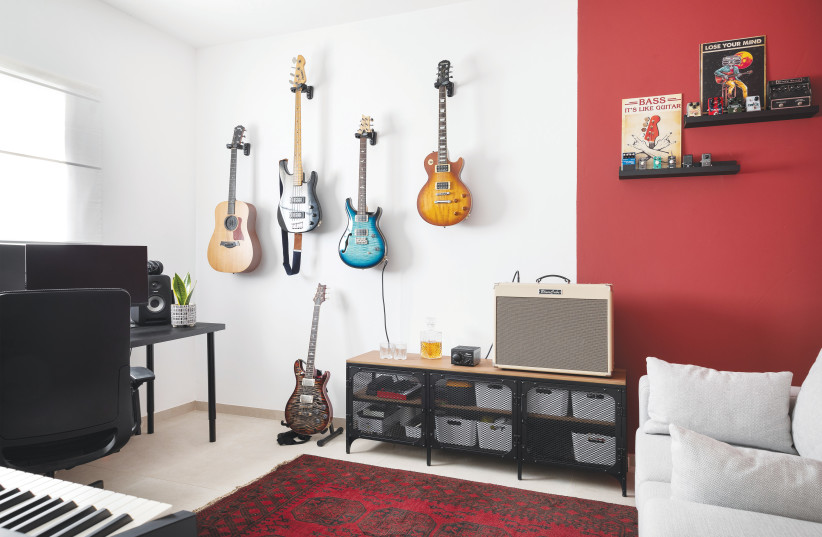
Music is a great way to counter stressful missile alerts. Shida Ruth Behrouz of Shida Interiors used her client’s hobby to make the Pardes Hanna room sing. With wall-mounted guitars and a cozy seating area, she helped her clients create a comfortable and happy space.
Ahuva Rhein of Ahuva Design was tasked with designing an addition to a home in Har Bracha – a mamad master bedroom with a private attached bathroom, including shower. After consulting with an architect who specializes in the rules of designing shelters, Rhein drafted the addition.
“This includes placing only one mamad window in the bedroom and special pipes for the air-conditioning system that will snake under the floors to drain outside the mamad into the garden,” she said. “In a mamad, you can’t dig into the walls, because that takes away from the strength of the walls. Instead, a plaster wall of 10 cm. will be built along the solid concrete 35-cm. walls of the mamad.”
Building safe rooms, she explained, presents unique challenges. With only one window in the bedroom and no window in the bathroom, the moisture from the bathroom can cause mold and mildew. To alleviate this problem, she designed a vent to go through a heavy cement pipe. Over that, she built a shelf.
She paid special attention to the lighting, using spotlights on the ceiling to create soft lighting near the beds.
To help make the room feel airy and spacious and not like you’re locked inside a bank vault, she added a regular door that opens into the safe room and closes inside the big steel door that seals off the mamad from the rest of the home.
Who pays? Who maintains?
Public shelters are primarily funded and maintained by local municipalities through property taxes (arnona) and sometimes through government grants. Groups of homeowners often pool their own resources – through fees or special campaigns – to maintain, clean, upgrade, and even retrofit shared shelters, adding better ventilation, lighting, or accessibility features, when municipal support falls short.
Even if the homeowners finance the shelter, it is illegal to turn someone away during an alert. That goes for all shelters – public and private. Whoever is in the neighborhood is entitled to enter your safe space until the risk is over, according to Section 15(f) of the Civil Defense Law, 5711-1951, which states, “The holder of a place that is a shelter must, during an attack, allow any person who is near the place to enter the shelter and to remain there for the entire duration of the attack.”
In some high-risk areas, the Home Front Command sets standards and may offer supplementary help in designing, building or inspecting shelters, and it has hotlines (#104 and #106) for anyone with questions.
Private mamads are paid for by homeowners, apartment buyers, and developers, with costs built into the price of new apartments.
In some cases, nonprofits and private donors are allowed to step in, especially near the borders, to build and equip additional shelters. The Jewish National Fund-USA has a bomb shelter program (sometimes called its Israel Resilience initiative). It is a major philanthropic effort by JNF-USA to build, install, renovate, and beautify bomb shelters across Israel, especially in high-risk areas like the Gaza border area and the northern border regions near Lebanon.
Most hospitals have created safe spaces in underground parking lots and other spaces, but 56% of beds remain unprotected, especially for patients who are not ambulatory.
When Soroka Medical Center suffered a direct hit by an Iranian missile, even the nearby buildings were affected, with windows, doors, and elevators blown out by the shock wave. First responders worked hard trying to move patients onto lower floors via the stairs and ramps. The strike on Soroka was a wake-up call that went largely unheeded.
While many hospitals developed underground facilities, one large hospital dealt with the challenge of an exposure to an infectious disease when alerts brought maternity patients and newborns together with patients battling infections and other illnesses in the closed protected space. Ensuring safe spaces in hospitals is still a work in progress.
The Starkest gaps: Arab towns and Bedouin communities
Nowhere is the inequality more painful than in Arab localities and unrecognized Bedouin villages. Per a 2018 special report by the State Comptroller’s Office, roughly 46% of Arab citizens lacked standard protection, compared to 26% nationwide. According to Home Front Command data (as of January 2025), only about 0.3% of Israel’s public shelters are in Arab municipalities.
According to Israeli media reports, local authorities, and NGO analyses following Iranian missile strikes in mid-2025, in Tamra, where four women were killed in an Iranian missile strike, there were no public shelters, and only 40% had private mamads. In Rahat (80,000+ residents), not a single public shelter exists. In unrecognized Negev Bedouin villages, tens of thousands live in tin-roofed homes with no protection at all. Residents shelter under bridges or in ditches. On October 7 alone, 20 Bedouin civilians were killed by rockets.
The city council of each town and village is responsible for funding and building shelters.
The human and economic cost
Neta, a mother on the northern confrontation line, told Almog Boker of Channel 12: “Do you know that according to the guidelines, I’m not supposed to open my business, because I don’t have a protected space – and nobody provides either a protection solution or an economic solution. But I still must make a living.”
She sends her children on separate school buses “so that if one is hit, I’ll still have another child left.”
Businesses across the country suffer. Owners without protected workspaces are forced to close during alerts or risk their lives and those of their workers. Chronic warfare has caused thousands of closures, lost revenue, and mental strain since October 7.
Keeping up with the shelters
The housing crisis worsens the problem. With Israel’s high fertility rates of almost three children per woman and its population growth outpacing many Western countries, it is also outpacing its infrastructure. More people need more places to live, but construction has slowed due to workforce shortages after October 7, with fewer construction workers in the workforce.
Meanwhile, illegal rentals in older neighborhoods and slow retrofitting mean fewer new protected spaces relative to the demand. As a result, existing shelters can get uncomfortably crowded.
Life inside the shelters: Strange bedfellows
It’s not all bad. Bomb shelters can create unexpected community.
In Haifa, student Faith was guided by a stranger to a shelter where seniors were learning bridge. She joined them for half an hour, made new friends, and even found a potential doctor.
Not every encounter is warm. One Tel Aviv woman described helping elderly neighbors to a nearby building shelter, only to be told, “Get out! This is not your sanctuary.”
Pets spark debate. Despite no legal prohibition, some owners are turned away. Advocate Amnon Keren reminds everyone that bringing pets is a right, aligned with Home Front Command guidelines and animal cruelty laws. In many shelters, dogs and children become stress relievers.
In Karnei Shomron, plumber Eliezer Cohen said their shared shelter of 35 regulars has hosted a wedding celebration, a two-day-old infant, traditional Shabbat songs, and whispered Psalms. “We always welcome strangers and dogs,” he said.
In Jerusalem, a friend recalled one mother’s 10-month-old baby turning the shelter into his personal stage, delighting the weary shelterers.
What to do if you have no shelter?
If you are among the 30% of people with no shelter nearby, the Home Front Command’s advice is clear: Move to an interior room or stairwell (at least two floors down), sit against an inner wall, protect your head, stay away from windows. Avoid kitchens and bathrooms. If you are in a car, stop beside an embankment.
The rush to safety itself carries a heavy price. Since the beginning of Operation Roaring Lion in February, more than 2,000 Israelis have been injured while rushing to shelters, according to Health Ministry data, as reported in multiple outlets (primarily Ynet) citing official figures up to late March 2026.
A detailed study conducted by Rambam Medical Center in Haifa examined 174 cases of orthopedic injuries recorded between October 2024 and June 2025 during periods of intense rocket fire from Lebanon and Iran. The researchers found that 88% of these injuries occurred inside the home, typically while people were running, stumbling, or falling on their way to a safe room. Over a third of the cases involved fractures, many of which required surgery. Elderly people were disproportionately affected – all the severe injuries in the study occurred among those aged 70 and older.
The Home Front Command and Magen David Adom observed throughout the war that the vast majority of serious civilian casualties since October 7, 2023, were not caused by direct rocket impacts inside protected spaces, but by people caught outside, either hurrying to a shelter, falling on stairs or in hallways, or while exposed to shrapnel and debris before reaching safety.
A national wake-up call
Despite decades of regulation and hard-won lessons, Israel remains woefully unprepared in too many places. Technology like Waze’s shelter finder helps, but many shelters on the map are moldy, unusable, or filled with storage. Underground parking and train stations are imperfect solutions, especially at 3 a.m. with children and pets.
We must do better. The government, municipalities, and the Home Front Command need to accelerate retrofitting, fully fund programs like Northern Shield, incentivize private additions, and maintain public shelters properly. Grants, fast-tracked permits, tax incentives, and support for homeowner-led upgrades should all be part of the solution.
Because when the next siren sounds – and it will – every Israeli deserves more than an updated app. They deserve a safe place.

